
1Executive Summary
Since the 1 February 2021 military coup in Myanmar and subsequent widespread protests, the Burma Human Rights Network has carefully documented and analyzed crimes committed by the Tatmadaw against Burmese civilians as a part of its campaign to suppress political opposition to the coup. The reporting period for the crimes documented is February to May 2021. BHRN has also documented the growing humanitarian crisis in Myanmar, which is attributable to intentional actions by the Tatmadaw to deny access to medical care and block humanitarian aid from reaching those in need.
Based on its legal analysis, BHRN believes that there are reasonable grounds to conclude that the Tatmadaw has committed crimes against humanity, namely murder, imprisonment and other severe deprivations of liberty, enforced disappearance, torture, other inhumane acts, and persecution based on political identity.
The present report also analyzes the responses to date to the Tatmadaw’s brutal and violent crimes against the Burmese people by States, various United Nations actors and entities, and the National Unity Government. BHRN believes that more actions are needed from these individuals and entities and makes recommendations to them with the aim of bringing about an urgent end to the Tatmadaw’s reign of terror against the Burmese people, to ensure accountability for the crimes committed, and to provide critical, life-saving humanitarian assistance to the Burmese people.
Acknowledgment. This report was prepared by Erin Farrell Rosenberg .1 It was reviewed by Ambassador Stephen J. Rapp2 and one expert in international criminal law who wishes to remain anonymous. The author and BHRN would like to acknowledge and express their appreciation to Ms. Nadira Kourt for her incredibly helpful feedback on drafts of this report. This report would not have been possible without the extraordinary efforts to collect and document information by BHRN’s UK and Burma-based staff and intermediaries, many of whom carried out this vital work in dangerous circumstances to themselves and their loved ones.
2Introduction
Since the 1 February 2021 military coup in Myanmar, the international community has repeatedly called on Myanmar’s military, the Tatmadaw, to immediately cease its violent attacks and human rights abuses against peaceful civilian protesters.3 Already in March, credible voices warned that the Tatmadaw’s brutal suppression of protesters may rise to the level of crimes against humanity.4 However, the international community’s condemnations and pleas have fallen on deaf ears. Now, only days before the six-month anniversary of the coup, the Tatmadaw continues undeterred and has even intensified its violent assault on Burmese civilians.
At the same time that these attacks are occurring, Myanmar is facing a quickly escalating humanitarian crisis, driven by the Tatmadaw blocking critical humanitarian aid from reaching vulnerable populations and its failure to manage a deadly third wave of the COVID pandemic sweeping through the country.
Despite the continued violence,the serious risk of death or injury, and deteriorating conditions of daily life, the Burmese people have bravely remained steadfast in their refusal to accept the imposition of military rule. The protests and strikes continue in the face of unimaginable brutality. Yet, while the Burmese people are united in their rejection of the military junta, the international community regrettably appears fractured and seemingly unable to muster a coordinated response capable of bringing a halt to the ongoing violence and crimes that the Tatmadaw is committing daily against its own people or to addressing the growing humanitarian crisis.
The international community’s failure to act has placed Myanmar in a perilous position. Absent a change in circumstances, Myanmar risks either collapsing into a failed state, into civil war, or facing the unacceptable reality of the military junta’s position becoming entrenched, leaving it free to continue to commit atrocities with impunity, with the serious risk that this will embolden the Tatmadaw to only increase the degree of brutality and violence.
Since the February 2021 coup, BHRN has carefully documented crimes committed by the Tatmadaw against Burmese civilians. The information collected is based on primary data collected and verified by BHRN in February, March, and April 2021. This information adds to that collected by other human rights organisations documenting the Tatmadaw’s criminal acts5 and as such represents only a portion of the types and number of criminal acts perpetrated by the Tatmadaw since the coup. BHRN has documented over 300 acts, involving more than 500 people, of murder, imprisonment, torture, enforced disappearance, other inhumane acts, and persecution. These documented acts provide reasonable grounds to conclude that the Tatmadaw has and continues to commit crimes against humanity.
With this report, BHRN hopes to spur the international community to do more – much more than it has to date – to bring about an urgent end to the Tatmadaw’s reign of terror against the Burmese people, to send a clear message that impunity for atrocity crimes will not be tolerated, and to provide critical, life-saving humanitarian assistance to the Burmese people.
3Background
A. The 1 February 2021 military coup
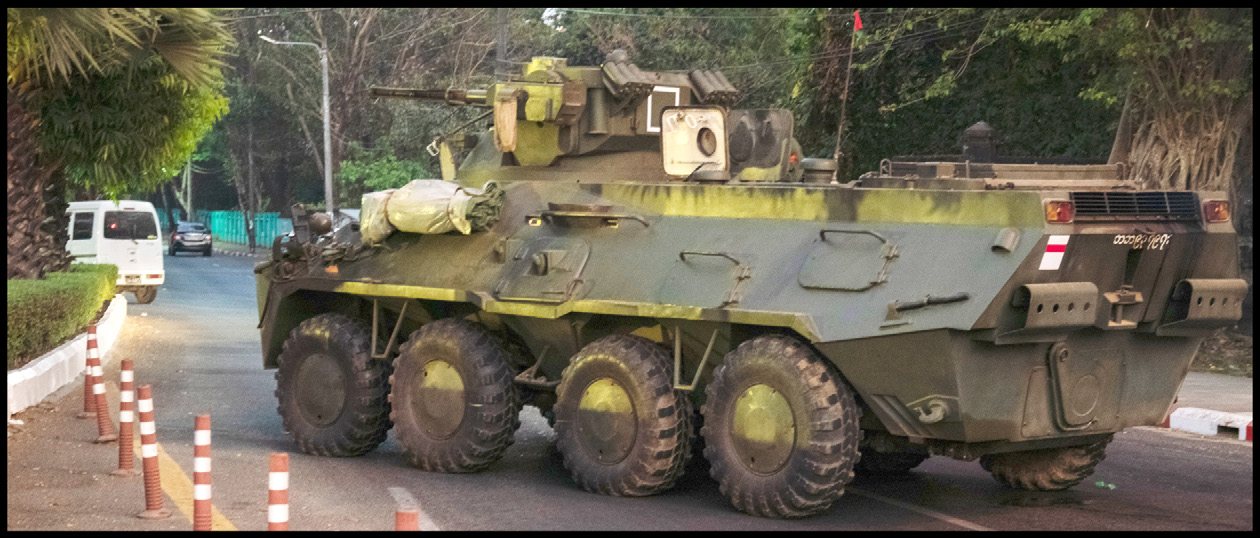
In 2011, after nearly a half century of military dictatorship, Myanmar began the transition to civilian-led democratic governance. In the 2015 national elections, the then opposition party, the National League for Democracy (NLD), headed by Aung San Suu Kyi, won overwhelmingly. However, due to provisions in the 2008 constitution,6 the Tatmadaw continued to retain a large degree of power within the government.
In the November 2020 national elections, the NLD again won a majority of parliamentary seats over the Tatmadaw-aligned political party, the Union Solidarity and Development Party (USDP). Immediately following the election, the Tatmadaw and USDP refused to recognize the results based on alleged election irregularities and fraud.7 On 28 January 2021, the Union Election Commission (UEC) rejected these allegations on the basis that any fraud was not widespread enough to call into question the election results, a decision that was supported by independent election monitors.8 The Tatmadaw and USDP, however, continued to refuse to concede the election.
Beginning in the middle of the night on 1 February 2021, before the newly elected parliament could be sworn in and certify the election results, the military coup began. Beginning with a national telecommunications shutdown, the Tatmadaw arrested government officials, including Aung San Suu Kyi and then President Win Myint, placed elected parliamentarians under house arrest, and detained political activists. Later that morning, the Tatmadaw invoked article 417 of the 2008 constitution’s “state of emergency” clause, which permits the military to assume control of the government for a period of one year, and, under article 418, transferred legislative, executive, and judicial power to Commander-in-Chief Min Aung Hlaing. The junta then announced the creation of the “State Administrative Council” (SAC) with Min Aung Hlaing as Chairman, and proceeded to appoint new heads of government ministries, replace the UEC members, and amended a number of laws.
Despite the junta’s claims to be acting “in defense of the constitution”, under the provisions and procedures of the 2008 constitution, the military takeover was illegal and in fact violated the constitution.9
B. The Burmese people’s response to the coup
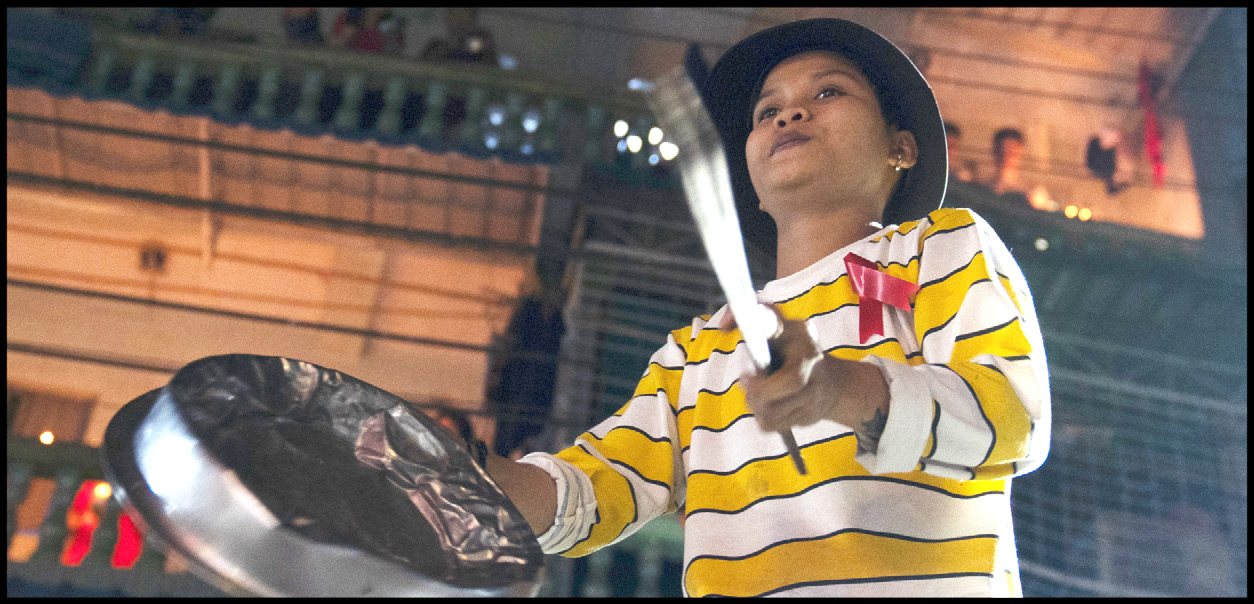
The Burmese people have come together in a nationwide display of unity to reject the military coup and demand a restoration of democracy in Myanmar. Immediately following the coup, millions of every day Burmese participated in a coordinated nighttime banging of pots and pans as a symbol of protest and resistance.10 Within days, the Civil Disobedience Movement (CDM) was born, comprised of people of different ethnicities, social and economic statuses, and all ages.11 While officially leaderless, young people have played a leading role in the CDM. The CDM has organized strikes, work stoppages, protests, and other activities intended to pressure the Tatmadaw to relinquish power.
On 8 February 2021, a group of NLD parliamentarians elected in the 2020 elections formed the Committee Representing Pyidaungsu Hluttaw (CRPH) and informed the United Nations and other governments that they are the legitimate government of Myanmar.12 On 16 April 2021, the CRPH announced the formation of the National Unity Government (NUG), as well as a list of the officials who would fill government positions.13 The NUG is comprised of NLD parliamentarians, anti-coup protest leaders, and representatives from ethnic minority groups, though it has no Rohingya representation.
C. The junta’s brutal campaign to suppress the protest movement
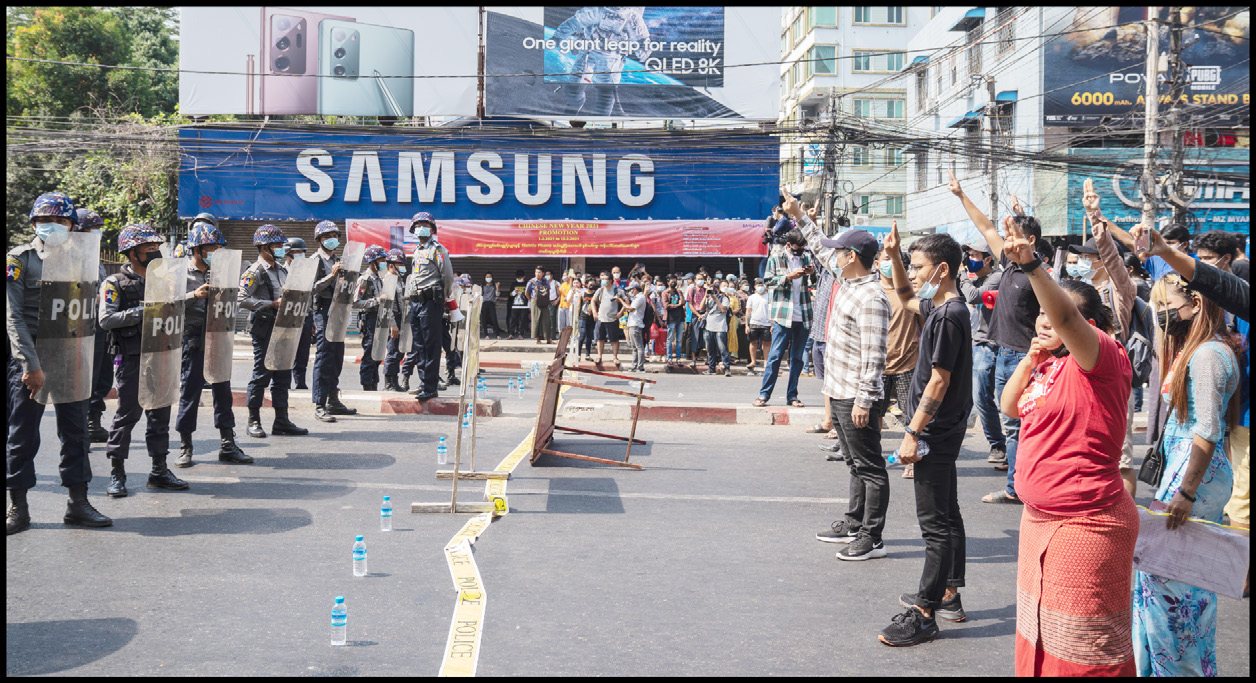
In response to the widespread protests and resistance, the Tatmadaw unleashed a brutal crackdown aimed at suppressing the protests. This campaign of violence has been carried out by the military and police, as well as junta-aligned local security forces and supporters, and includes the widespread use of heavy artillery and air strikes on civilian population areas thought to be sympathetic to the protests, as well as the looting of homes and destruction of personal and public property. The violence has been compounded by the junta’s imposition of martial law in local areas, the blockage of humanitarian aid, and phone network shutdowns.
The impunity with which the Tatmadaw carries out its criminal acts has created an overall climate of fear amongst the civilian population, with many of those who have not been directly victimised afraid to leave their homes. According to Michele Bachelet, the UN High Commissioner for Human Rights, an estimated 200,000 persons have been fled their homes in fear of the Tatmadaw’s violent military raids on civilian neighborhoods and villages.14 In Kayah state alone, more than 100,000 people have been displaced by the violence, with many forced to flee across international borders in search of safety.15
D. The dire humanitarian crisis in Myanmar
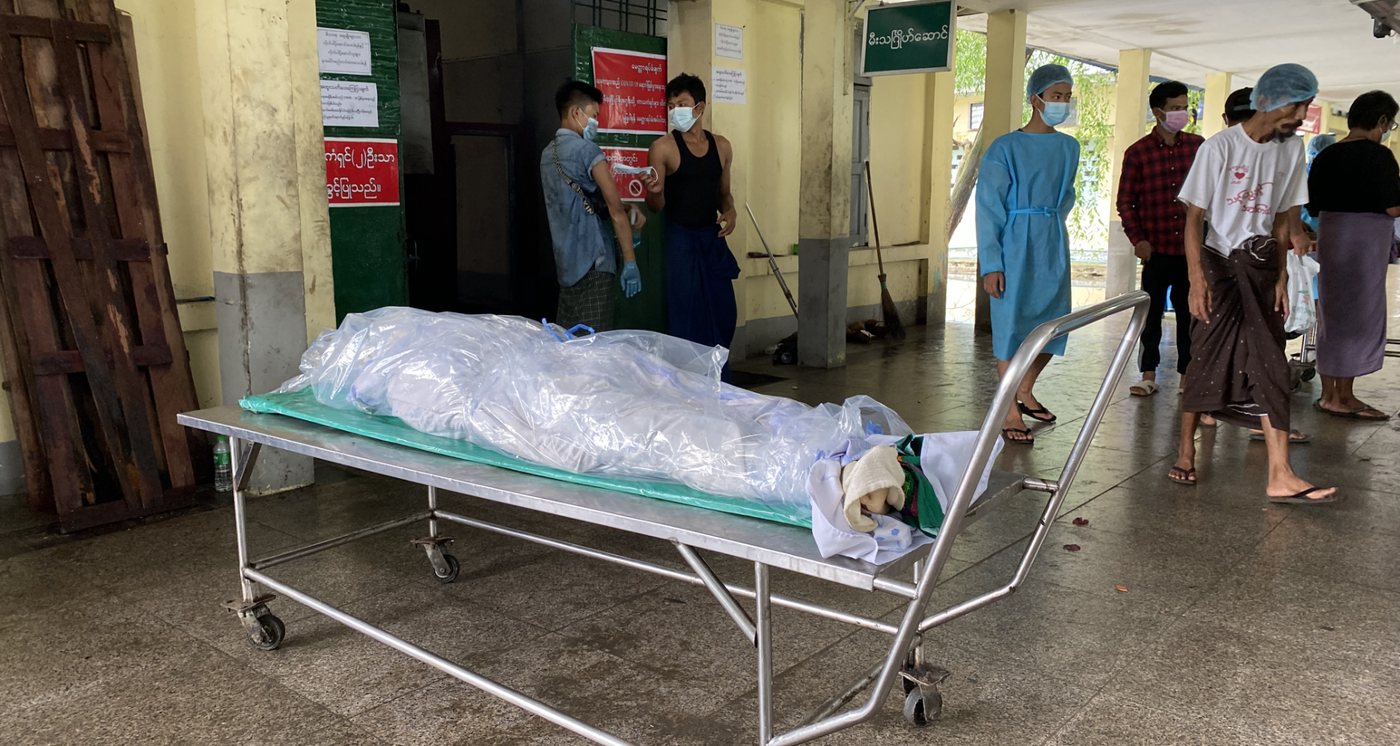
“The situation in Burma is truly desperate. The people have no protection from Covid-19 and the military has made treatment impossible for so many. The international community must work together to stop this disaster from worsening. It must be made clear to the Burmese fascist military that their abhorrent hoarding of medical supplies and abuse of medical workers will not be tolerated.”
Kyaw Win, BHRN Executive Director16 At the same time that the Tatmadaw is unleashing brutal violence on its own people, it is also failing to manage a humanitarian crisis that is worsening daily. In this respect, Tom Andrews, the UN special rapporteur on human rights in Myanmar, has recently warned that the “explosion of COVID cases, including the Delta variant, the collapse of Myanmar’s health care system, and the deep mistrust of the people of Myanmar of anything connected to the military junta, are a perfect storm of factors that could cause a significant loss of life in Myanmar”.17
The Tatmadaw’s failures cannot be attributed to conditions outside of its control. To the contrary, the Tatmadaw is taking purposeful actions that are exacerbating and worsening the public health crisis.
In this regard, it is the Tatmadaw’s violent suppression of dissent post-coup that has decimated the health care sector. As noted by the media source, Myanmar Now: “Among the first to resist the junta were medical professionals at public hospitals, who refused to work under a military dictatorship. This led to the arrest of many who were at the forefront of the battle against the pandemic last year.” As just one example of many, in an action that prioritizes maintaining its illegitimate hold on power over responding to the needs of the Burmese people, the Tatmadaw has mandated that only facilities under its control be allowed access to oxygen and banned its sale to the public.19 The Tatmadaw’s culpability for the current humanitarian crisis was comprehensively summarized by the Global Centre for the Responsibility to Protect, which recently stated that:
“Since the coup, the security forces have targeted healthcare professionals treating injured protesters and have issued hundreds of arrest warrants for doctors and nurses accused of supporting the civil disobedience movement. At least 12 doctors have been killed by the military since February, while the World Health Organisation has recorded at least 240 attacks on Myanmar’s health care workers, ambulances and medical facilities. The junta has also arrested the head of the COVID-19 vaccination campaign, who was appointed by the former government.
The security forces have also occupied dozens of hospitals across the country, in violation of international law, discouraging patients from seeking medical help. Additionally, many people cannot access healthcare due to coup-related curfews and high medical costs, with hundreds of COVID-19 patients reportedly dying at home.”20
Finally, the decisions of border state countries to close border crossings and prevent the importation of desperately needed medical equipment, supplies, and other humanitarian aid is compounding the already desperate situation in which the people of Myanmar find themselves.
4Analysis of the Tatmadaw’s Crimes against Humanity
“It’s not a case of a renegade commander using particularly ruthless tactics on peaceful protesters. This is widespread. It’s systematic. It is clearly, in my view, crimes against humanity being committed before our very eyes.”
Tom Andrews, UN special rapporteur on human rights in Myanmar21
A. Introduction
The Tatmadaw’s violent campaign of suppression against its civilian population has shocked the international community. As the violence has continued for months on end, calls for restraint and respect for human rights have given way to calls for accountability, as the world has started to acknowledge that what is occurring in Myanmar is not only an assault on a fledgling democracy, but also entails the commission of widespread atrocity crimes that require a strong response in their own right.
BHRN strongly shares the view that the Tatmadaw’s brutal assault on its civilian population cannot be ignored, and that accountability must not be a bargaining tool in attempts to restore civilian-led democracy in Myanmar. A healthy democracy cannot be sustained when its foundations rest on a lack of accountability and justice. It is in this spirit that BHRN has prepared this report and chosen to focus its analysis on the Tatmadaw’s commission of crimes against humanity.
Crimes against humanity represent some of the most serious crimes known to mankind, causing such long-term, devastating consequences to individuals, communities and entire societies that they “deeply shock the conscience of humanity”.22 While there is not yet an international treaty dedicated solely to crimes against humanity, they are prohibited by widely ratified treaties such as the Rome Statute of the International Criminal Court (ICC).23 Over the last 75 years, various individuals have also been successfully prosecuted for crimes on the basis of customary international law. The prohibition of crimes against humanity is widely accepted as a peremptory norm of international law (also known as jus cogens status) , meaning that the prohibition is applicable to all States, without the need to establish a treaty obligation, and cannot be derogated from.24 Crimes against humanity may potentially give rise to both State responsibility25 and criminal liability for individuals.
While this report focusses on the commission of crimes against humanity, BHRN is keenly aware that this analysis does not capture all of the human rights violations that have been perpetrated by the Tatmadaw. Since the military coup, the Tatmadaw has committed a number of serious violations of international human rights law, including violations of the right to life,26 the right to be free from torture,27 the right to movement,28 access to food, medical supplies and care,29 and freedom of expression.30 In addition, specifically with respect to children, the Tatmadaw’s suppression campaign has resulted in numerous violations of its human rights obligations under the Convention on the Rights of the Child.31 Children have been killed, arbitrarily detained, and subjected to forced labor. The situation for children is so severe that the NGO Save the Children has declared Myanmar “no longer safe for children”.32 An infographic can be found at the end of this report, in which BHRN has set out the incidents that it has documented with respect to the serious, widespread human rights violations that the Tatmadaw has committed against the Burmese people during the reporting period.
In addition, this report does not address the issue of potential war crimes, perpetrated by either the Tatmadaw or the various ethnic armed groups. However, BHRN has reviewed credible information that suggests that the Tatmadaw may be committing war crimes in those parts of the country where it is involved in a non-international armed conflict, such as the use of child soldiers, the destruction of protected property, and attacks on medical and humanitarian aid personnel. BHRN underscores that international human rights law continues to apply alongside international humanitarian law during armed conflicts. Likewise, crimes against humanity may be committed in addition to war crimes during an armed conflict.
Finally, BHRN notes that other organisations have documented incidents that may also rise to the level of crimes against humanity, such as rape and other forms of sexual violence, and the forcible transfer of a civilian population. This report should be read as complementing and adding to the important work carried out by these other organisations and UN bodies.
In the rest of this section of the report, the information that BHRN has compiled regarding the Tatmadaw’s commission of prohibited acts constituting crimes against humanity against the Burmese civilian population is presented. For each crime against humanity, the relevant law is first set out, beginning with the contextual elements. Next, BHRN’s documentation of the underlying prohibited acts is summarized. Given the number of individual incidents documented, not each incident is described. Incidents that are representative of the broader pattern of crimes are described in more detail.
The methodology used in this section follows that used by the International Fact- Finding Mission on Myanmar (FFM). First, in terms of the standard of proof, the “reasonable grounds” standard has been applied, meaning that alleged incidents and patterns of conduct are based on reliable and credible first-hand information.33 This would mean, at least in some jurisdictions, that sufficient evidence exists to trigger a prosecution, even if it would not necessarily be sufficient evidence to convict a person beyond reasonable doubt.
BHRN carefully reviewed video evidence, the majority of which has been shared publicly by reputable news outlets and human rights organizations, and verified the information through interviews with eyewitnesses, victims, and family members through Myanmar-based intermediaries. In this regard, the information compiled by BHRN is consistent with and corroborates other publicly available reports and expert statements regarding the Tatmadaw’s criminal conduct. Second, the legal definitions for crimes against humanity set out in article 7 of the Rome Statute of the ICC is used, as well as the jurisprudence of the ad hoc tribunals when relevant.34 The Rome Statute framework is also considered most appropriate to use given the FFM’s recommendation, also made by expert commentators35 for the United Nations Security Council to refer the situation in Myanmar to the ICC.36
B. The contextual elements of crimes against humanity
Crimes against humanity differ from ‘ordinary crimes’ in that they require the establishment of ‘contextual elements’, meaning that the underlying prohibited act/s must be committed as part of a widespread or systematic attack directed against a civilian population in furtherance of a State or organizational policy.37
Article 7 (1) of the Rome Statute sets out the following prohibited acts:
- murder
- extermination
- enslavement
- deportation or forcible transfer of population
- imprisonment or other severe deprivation of physical liberty
- torture
- rape, sexual slavery, enforced prostitution, forced pregnancy, enforced sterilization, or any other form of sexual violence of comparable gravity
- persecution against any identifiable group or collectivity based on political, racial, national, ethnic, cultural, religious, or gender, in connection with one of the acts listed here or other criminalized acts
- enforced disappearance of persons
- apartheid; and
- other inhumane acts intentionally causing great suffering, or serious injury to body or to mental or physical health) that are “committed as part of a widespread or systematic attack against any civilian population, with knowledge of the attack”.
Put plainly, this means for example that the ‘ordinary’ crime of murder becomes a crime against humanity when it is committed as part of a widespread or systematic attack directed against a civilian population in furtherance of a State policy.
In terms of the meaning of the various parts of the contextual elements, an ‘attack’ is a “course of conduct involving the multiple commission of acts referred to in paragraph 1 against any civilian population, pursuant to or in furtherance of a State or organizational policy to commit such attack”. The acts do not need to constitute a military attack.38 “Directed against” means that a civilian population must be an intended target of the attack, rather than an incidental target.39
The ‘policy’ requirement means that the State or organization must “actively promote or encourage” the attack.40 This “ensures that the multiple acts forming the course of conduct are linked”, such that “acts which are unrelated or perpetrated by individuals acting randomly on their own are excluded”.41 However, while a “policy may consist of a pre-established design or plan”, it “may also crystalli[z]e and develop only as actions are undertaken by the perpetrators” and its existence “may be inferred from a variety of factors”.42
The term ‘widespread’ refers to “the large-scale nature of the attack and the number of its victims”, as well as its geographic dimensions in the sense of the attack occurring in multiple locations, whereas ‘systematic’ means the “organized nature of the acts of violence and the improbability of their random occurrence”,43 often indicated by “the existence of ‘patterns of crimes’”.44
C. BHRN’s documentation of prohibited acts
1. Murder
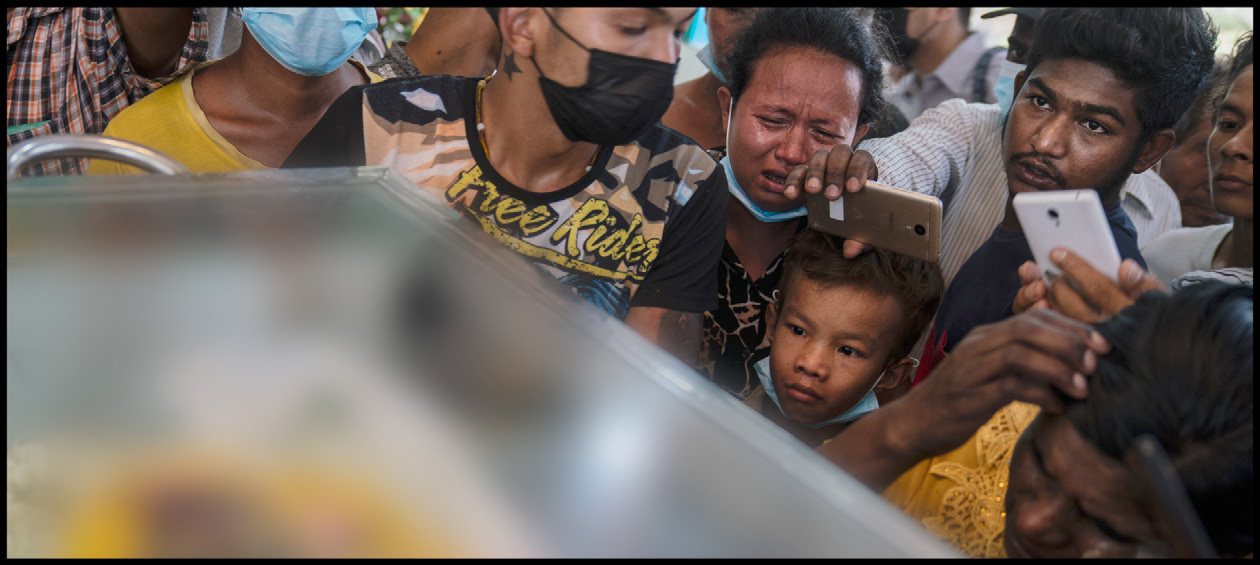
Murder is the unlawful killing of a human being where the perpetrator meant to cause death or was aware that it would occur in the ordinary course of events.45 The elements of murder can be established even where the victim’s body has not been recovered.46
BHRN has verified credible information establishing a consistent pattern of acts of murder of civilians. BHRN has documented more than 150 murders over the three- month period of this report.
Many of the killings occurred while the persons were in the custody of the Tatmadaw, with their families being instructed to collect their bodies the following day. In these situations, many of the victims’ bodies bear signs of having also been tortured.
For example, on 7 March, in Muse, a male protester was arrested by police. According to witnesses, he was uninjured at the time of his arrest. He was held for five days, at which point his family was instructed to come and collect his body. Photographic evidence of the corpse shows signs of torture, with multiple injuries and bruising covering much of his torso.
Similarly, on 8 March, in Yangon, an NLD member was arrested. His body was released the following day. While the exact cause of death was not established, photographic evidence of his corpse shows that he was tortured overnight during detention.
Other killings occurred as a result of the Tatmadaw shooting directly at protesting civilians, using live ammunition, rubber bullets aimed at the head, and beatings. In some documented incidents, the military used heavy weaponry, such as machine guns, and explosive bombs.
In one incident, on 6 March 2021, in Mandalay, a 20-year-old attending a protest was shot by police. Eyewitnesses stated that he was then beaten to death. While the military claimed that the man was armed, this is disputed by eyewitnesses who state that he was peacefully attending the protest with others when he was shot and then beaten to death.
On the morning of 7 March, in Taunggyi, two young people attending a protest were shot with rubber bullets and died from their injuries. Eyewitnesses confirm that the protest was peaceful when the police opened fire.
In another documented incident, on 11 March, in Myaing, six people were killed and eight others were injured when protesters were fired on by military forces with live ammunition. Photos show that several of the killed protesters were shot in the head.
One of the deadliest incidents occurred on 14 March 2021 in Hlaing Thar Yar township, where at least 30 protesters were killed and scores more injured. The incident happened following arson attacks on Chinese factories in the area that occurred overnight. The Tatmadaw used the arson attack as a justification for its use of deadly force. No evidence has been put forward to connect any of the protesters with the arson attacks. Furthermore, neither the arson attacks in themselves, nor efforts to apprehend the perpetrators of the arsons provide a legal justification for an indiscriminate attack on civilians who happen to be gathered nearby.
On 1 April, in Mandalay, three people were killed and at least 20 injured when the military attacked a peaceful protest with machine gun fire and explosive bombs. Photos from the scene show gruesome scenes of devastation with large pools of blood, destroyed and burned property, and victims with catastrophic injuries from the machine gun fire. Fragments and unexploded bombs were recovered on the scene, demonstrating their use by the military in the assault.
While many killings occurred in the context of civilians participating in peaceful protests, a significant number of the documented killings involved people being shot indiscriminately, regardless of their actual involvement in a protest. The victims include persons of all ages, including elderly women, teenagers, and young children.
For example, on 23 March 2021, four people were killed in Mandalay during a military- led assault on a peaceful protest. Those killed include two people who were merely in the vicinity of the protest. A 7-year-old child was shot in the stomach and subsequently died from her injuries. The next day, a 16-year-old boy was shot in the head by security forces.
Similarly, on 3 April, in Kalay, a 13-year-old boy was shot and killed by the military, despite having no involvement in protests. The boy had run out of his home because he was scared by the nearby gunfire. Local witnesses confirmed that the boy was shot in the stomach and died from his injuries.
2. Imprisonment or other severe deprivation of physical liberty
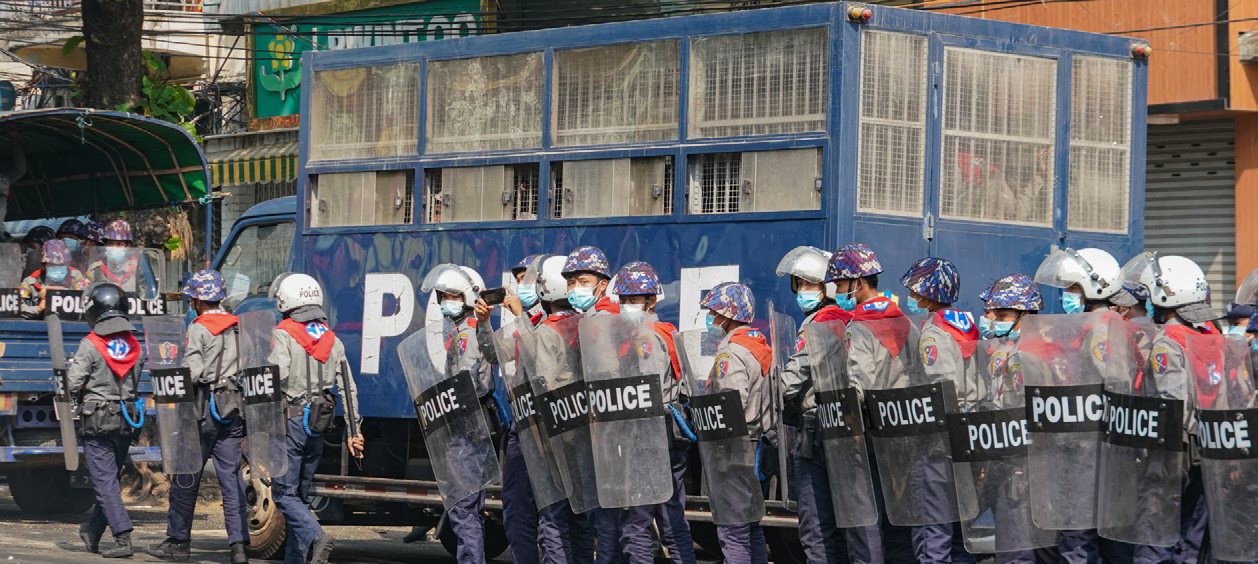
Imprisonment occurs when the perpetrator imprisons one or more persons or otherwise severely deprives them of their liberty.47 The imprisonment must be arbitrary.48 Factors that may be taken into account when determining whether the crime of imprisonment has occurred are whether (i) there was a valid warrant of arrest; (ii) the detainee was informed of the reason for his or her arrest; (iii) the detainee was formally charged; and (iv) the detainee was informed of any procedural rights.49
BHRN has verified credible information establishing a consistent pattern of acts of arbitrary detention and imprisonment of civilians. While an exact figure cannot be given from the incidents documented by BHRN, the Assistance Association for Political Prisoners (Burma) has documented over 5,000 cases of persons who have been arbitrarily detained and imprisoned.50
As has been well documented by numerous reliable news sources, civilians have been arrested en masse for exercising their right to freedom of expression at peaceful protests.
In one incident on 19 February, in Myitkyina, video evidence shows the police chasing protesters on motorcycles throughout the city center, as well as protesters and journalists being beaten with clubs. An unknown number of protesters can be seen in the video being arrested and loaded into police vans.
On 12 March in Mogok, an unknown number of monks and civilians were violently arrested by police and military while peacefully protesting in front of the monastery. The next day, 20 people were arrested in Gyar Thatharpai quarter in Mandalay.
On 22 March, fifteen protesters were arrested by security forces in Nwe Aye Ward, Dawbon Township. The video evidence shows that the protesters were unarmed and not protesting violently. The protesters can be seen being led away in a line with their hands above their heads, while a large number of security forces surround them with guns trained on the protesters.
In another incident on 26 March, the military and local Council security forces carried out mass arrests of protesters in Myeik. Witnesses reported that these forces also beat and killed protesters during the arrests.
In addition to protesters, journalists, members of civil society, and bystanders have also been arbitrarily arrested. For example, on 14 February, 7 journalists were arrested in Myitkyina while covering a CDM protest. Similarly, on 13 March in Taunggyi, a Polish photojournalist was arrested for taking pictures of the military.
On 23 March in Pathein Town, Ayeyarwaddy, the president of the Human Rights Protection Group was arrested by over 50 military and police forces. According to media reports, 10 other political activists were also arrested in Pathein. In another incident on 20 April in Yangon, police came to arrest an NLD member, but were not able to find him, and instead arbitrarily arrested his sister in his place.
Finally, civilians have also been arbitrarily arrested during military raids of homes, workspaces, and places of worship.
In one incident, in Htauk Kyant township in Yangon, the military raided the home of a Muslim religious leader and arrested nine people. In another incident, in Tharyarwadi Township on 10 March, a school principal was arrested in her home for her participation in the CDM movement. Witnesses reported that military and police forces could be seen gathering on the road in front of her home prior to the arrest.
3. Enforced disappearance
Many of the persons subjected to arbitrary arrest and detention may also have been victims of the crime against humanity of enforced disappearance.51 Enforced disappearance means the arrest,52 detention or abduction of persons by, or with the authorization, support or acquiescence of, a State or a political organization, accompanied by a refusal to acknowledge that deprivation of liberty or to give information on the fate or whereabouts of those persons, with the intention of removing them from the protection of the law for a prolonged period of time.53
As noted by Amnesty International: “many victims of enforced disappearance have been arbitrarily arrested or detained – in other words, arrested or detained without a warrant of arrest.”54 Persons forcibly disappeared are also at a higher risk of being tortured while in detention.55
In many of the arbitrary detentions documented by BHRN, the individuals were not formally charged, and their families endured extended periods of time without information as to their whereabouts, their condition, or being able to communicate with them. As is detailed in the below section, many of the victims of enforced disappearance were subjected to torture or killed.
Finally, while the Tatmadaw recently released a number56 of protesters who were in detention, this subsequent act does not render either the arbitrary detention or enforced disappearance legal,57 nor does it remedy the severe mental harm inflicted on both the individuals detained and forcibly disappeared and their families. Being arbitrarily detained without due process and forcibly disappeared for a prolonged period, even in the case of eventual release, causes long term trauma to the victims and their families.
4. Torture
Torture as a crime against humanity58 is the intentional infliction of severe pain or suffering, whether physical or mental, upon a person in the custody or under the control of a perpetrator.59 It does not include pain or suffering arising only from, inherent in or incidental to, lawful sanctions.60
BHRN has verified credible information establishing a consistent pattern of acts of torture of civilians, oftentimes occurring during detention. Several of these incidents have already been described in the section detailing acts of murder.
In an incident on 17 March in Thingangyun township, a protester was arrested after suffering a leg shot wound. Witnesses confirmed that the individual had only suffered an injury to his leg at the time of his arrest. However, when his body was finally returned, his face was disfigured with a large part of his upper lip missing, demonstrating catastrophic wounding to his face.
In another incident in Naypyitaw on 31 March, an NLD Executive Committee member was arrested and died after being tortured at the interrogation centre. His family was instructed to collect his body the following day.
Photographic documentation of the bodies of murdered civilians shows that the abuse they suffered rises to the level of causing severe pain, both physically and mentally. Many of the bodies are covered in bruises, particularly in the face and abdomen area. In addition, bullet wounds appear to not have been treated, indicating that the person were kept in detention without receiving medical care for serious injuries.
Finally, in one particularly horrific incident that occurred on 23 April in Pan Taung township in Bago, a two-year-old girl was arrested with her parents and grandfather. The father and grandfather were then tortured in front of the infant until they confessed to participating in setting a fire. According to villagers, the infant was extremely traumatized and scared even after she was released.
5. Other inhumane acts
Article 7 (1) (k) of the Rome Statute defines the crime against humanity of ‘other inhumane acts’ as “acts of a similar character intentionally causing great suffering, or serious injury to body or to mental or physical health”.
This crime is often referred to as a “catch-all” provision meant to address acts that are not specifically listed as a crime against humanity in a particular statute, but are considered to be of a “similar character,” meaning that the nature and gravity of the act are similar to a listed crime against humanity.61
As is set out in the section on the humanitarian crisis in Myanmar, the Tatmadaw is actively and purposefully depriving the Burmese people of critically needed medical care, including by blocking the provision of humanitarian aid, preventing civilians from obtaining life-saving oxygen and targeting medical providers based on their perceived political identity. Depriving COVID victims of oxygen and other medical care intentionally causes great suffering and serious injury to physical and mental health, and indeed is often fatal. The intentional deprivation of medical care committed by the Tatmadaw in this respect can be considered of a similar nature and gravity to the listed crime of torture and thus qualify as the crime against humanity of ‘other inhumane acts’.
Additionally, the number of persons seriously injured by the military and police is much higher than those killed. In addition to shooting civilians, military and police forces have used grenades, flash bombs, and other explosive weapons, as well as tear gas, to attack protesters, causing untold number of serious injuries. The military has also injured an unknown number of persons not involved in protests. For example, on 22 February, in Myitkyina, a child came out of his home to watch the military cars pass on the nearby road. Military officers in one of the passing cars opened fire, hitting the child in the head and seriously injuring him. To the extent that these acts inflicted great suffering, or caused serious injury to body or to mental or physical health, they may also qualify as ‘other inhumane acts’.
6. Persecution
Persecution is the intentional and severe deprivation of fundamental rights under international law based on the identity of the group (meaning based on the group members’ political, racial, national, ethnic, cultural, religious, or gender identity).62 Persecution is the only crime against humanity that requires a specific discriminatory intent. This means that the crime of persecution requires that the underlying act be carried out with the intent to discriminate on a prohibited basis. It also requires that the persecutory act be ‘in connection with any act referred to in this paragraph [article 7 of the Rome Statute] or any crime within the jurisdiction of the Court’, an additional requirement to what is required under customary international law.63
A single prohibited act may be charged or result in a conviction both as a listed crime against humanity and as the crime of persecution. This is because the crime against humanity of persecution has the distinct element of discriminatory intent.64 In this regard, each of the above listed crimes against humanity (murder, imprisonment and deprivation of liberty, enforced disappearance, and torture) are not only crimes in their own right, but are also underlying acts of the crime of persecution. Due to the role that ethnicity plays in Burmese politics, there is some degree of overlap between the ethnic and political identity of the victims. However, from the perpetrator perspective there are credible grounds for concluding that these acts are motivated by discriminatory intent based on the perceived political identity of the civilians. Similarly, denial of access to medical care and violations of bodily integrity through acts of serious physical violence represent severe deprivations of fundamental human rights and are also underlying acts of the crime of persecution due to their being committed based on the political identity of the ‘group’, i.e., the anti-coup protesters.
In addition, BHRN has documented a number of incidents involving destruction of property, both personal and religious, that has been carried out as a part of the Tatmadaw’s campaign to terrorize civilians that it considers sympathetic to the protest movement. The majority of acts of property destruction that BHRN documented occurred in the context of people being arrested or arbitrarily detained without cause.
Typically, one of the major differences between crimes against humanity and war crimes is that crimes against humanity relate to crimes against persons and not property.65 However, according to the jurisprudence of the International Criminal Tribunal of the Former Yugoslavia, destruction of property may, depending on the nature and degree of destruction, constitute an underlying act of the crime of persecution.66
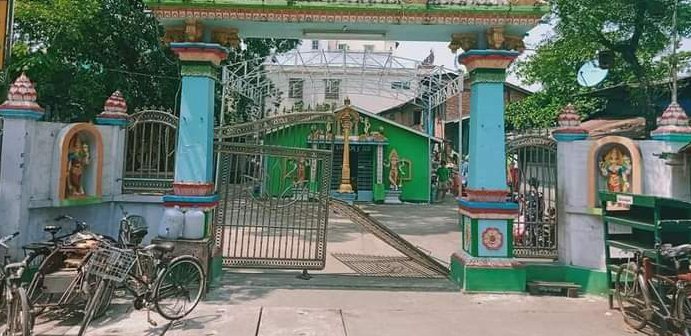
With respect to the destruction of religious property, in one incident, in Mandalay on 28 February, a large number of military officers are shown gathering around the gate of a mosque compound. They proceed to shoot the gate open and then advance into the compound. Gunshot fire can be heard continuously and the mosque’s interior was destroyed. In another incident, on 18 March in Thingangyun township, police and military forces destroyed the doors of a Hindu temple while they were arresting people.
Other incidents documented by BHRN relate to the destruction of personal property. During the night of 14 March, police officers set a number of cars on fire that were parked near the market. Photos of the destruction show a large number of vehicles, all completely destroyed. Similar destruction of vehicles carried out by police and Council security forces were documented during the month of March in Yangon and Taunggyi, including incidents involving several dozens of cars and motorcycles being destroyed at a time on 9, 19, 20, and 25 March.
Police and military forces also destroyed businesses of civilians perceived to be sympathetic to the protesters. On 3 April in Mandalay, a café shop near a protest location was destroyed by the military. Similarly, on 25 March in Taunggyi, another café was destroyed, along with a number of cars and motorcycles. During this same assault, civilians were arrested and one person was killed.
Finally, BHRN has also documented multiple incidences where civilians’ homes were pillaged while they were being arrested or interrogated.
D. Conclusion
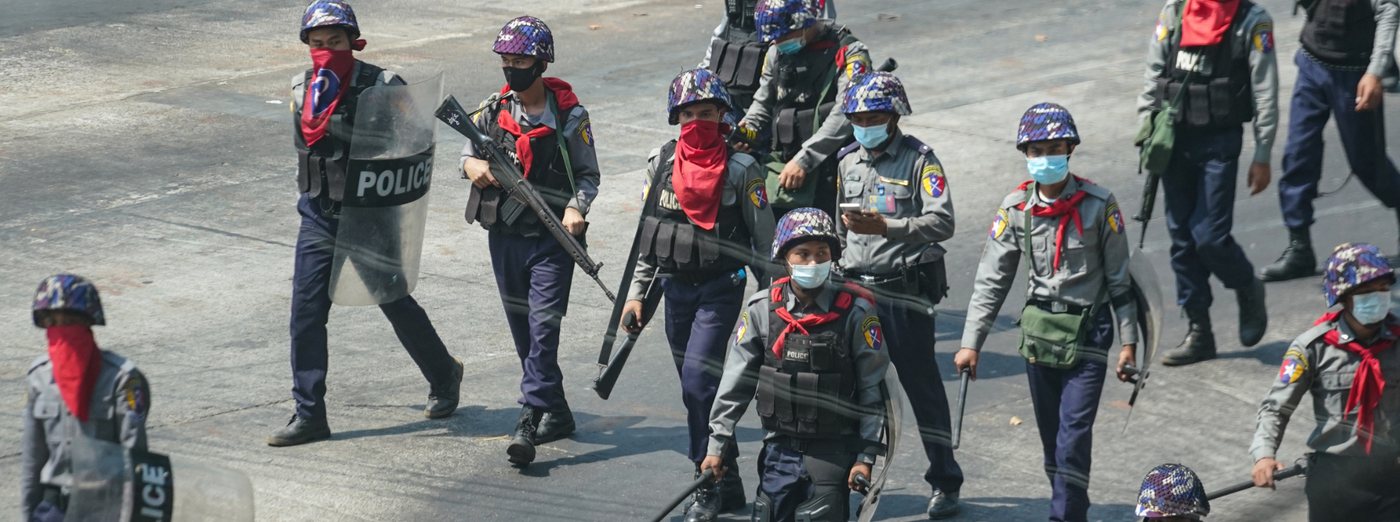
In addition to BHRN’s own documentation, reliable and credible information from UN and NGO reports establish that the Tatmadaw is carrying out a widespread and systematic “attack” against its civilian population, in furtherance of its policy to repress any real or perceived objection to the imposition of a military dictatorship. The attack is being directed against the Burmese civilian population and not against combatants. BHRN’s documentation, set out above, demonstrates the widespread nature of the attack, both in terms of its geographic scope and the hundreds of victims, as well as its systematic nature. The documentation shows that these acts are being carried out by military, police, and junta-affiliated armed groups, evidencing a high level of coordination.
The attack is being actively encouraged by junta leadership at the highest levels. In March 2021, the state-controlled media issued a threat to peaceful civilian protesters that they were “in danger of getting shot to the head and back”.67 Furthermore, according to credible media sources, an internal memo issued on April 11 by military leaders in Naypyidaw instructs military officers that: “You must annihilate [the protesters] when you face them,” and that “officers at all levels have to follow these instructions strictly”.68
Accordingly, there are reasonable grounds for concluding that the contextual elements for crimes against humanity have been established. Furthermore, there are equally reasonable grounds for concluding that the Tatmadaw’s attack against the civilian population includes the multiple commission of acts of murder, imprisonment or other severe deprivation of physical liberty, enforced disappearance, torture, other inhumane acts, and persecution based on political identity.
5Responses to The Tatmadaw’s crimes and the growing humanitarian crisis
BHRN reiterates its strong conviction that the Tatmadaw’s crimes against humanity cannot be ignored, must be urgently stopped, and that there must be accountability for the crimes committed. BHRN also calls upon all actors to take urgent steps to address the humanitarian crisis in Myanmar. In this next section, the responses and proposals of various actors, including the NUG, individual States, and the United Nations, are discussed.
A. The NUG’s response
At the outset, BHRN emphasizes that it recognizes that the NUG is not in a position to undertake certain acts, particularly in relation to accessing international justice mechanisms, because it has not yet gained recognition as the legitimate representative of Myanmar from any other State or UN body. In this regard, BHRN welcomes the “Policy Position on the Rohingya in Rakhine State”69 issued by the NUG on 3 June 2021, but it shares the concerns expressed by certain States regarding the need for the NUG to further clarify its position with respect to the rights of the Rohingya ethnic minority, including officially recognizing their identity and ethnic rights, restoring their citizenship, and repealing discriminatory laws that target the Rohingya. The NUG is strongly encouraged to demonstrate its commitment to forging a truly representative and inclusive path forward for Myanmar and all Burmese people by including members of the Rohingya community, as well as other Muslim groups, within the NUG and appointing them to government positions.
Despite the present lack of international recognition, BHRN considers it important to address recommendations to the NUG, given that, in BHRN’s view, the NUG is the only potential legitimate representative of the State of Myanmar. BHRN considers that the Tatmadaw’s conduct has rendered it wholly illegitimate and that any future Tatmadaw role in a restored civilian-led government represents an absolutely unacceptable option for Myanmar’s future, which must be rejected by all interested parties.
The NUG has publicly called for the Tatmadaw to be held accountable for the crimes it has committed post-coup. On 9 April 2021, representatives of the NUG met with the Independent International Mechanism for Myanmar (IIMM)70 to discuss “the modalities of dialogue and co-operation” between the NUG and the IIMM with respect to the IIMM’s investigations and evidence collection related to potential crimes committed post-coup.71
On 30 May 2021, the NUG announced that it was “taking every step to cooperate with the International Court of Justice”72 and was “actively considering accepting the jurisdiction of the International Criminal Court” with respect to crimes committed since the military coup.73
BHRN welcomes these public statements from the NUG and encourages it to continue cooperating with the IIMM, the ICJ, and the ICC. However, with respect specifically to the ICC, BHRN considers that the NUG should clarify the procedural avenue it intends to use to accept the Court’s jurisdiction. In this respect, BHRN observes that there are two distinct avenues, either ratifying the Rome Statute and becoming a member state or by lodging an article 12 (3) declaration. An article 12 (3) declaration is an avenue available to non-State Parties , which permits such States to accept the jurisdiction of the Court over a limited number of defined crimes without becoming a State Party to the Rome Statute. For much too long, Myanmar has been governed by a culture of impunity and non-respect for the rule of law. BHRN believes that an article 12 (3)
declaration falls short of putting Myanmar on a path to sustainable peace and democracy and encourages the NUG to publicly commit to ratifying the Rome Statute. This will ensure that there is no future impunity gap in the case that crimes against humanity are once again committed by the State.
In addition, BHRN believes that an important aspect of justice and accountability is that there is a possibility for the Burmese to seek justice within their own domestic judicial system. The NUG is strongly encouraged to set out in detail how it intends to address the current legal regime that provides immunity to military officials for crimes that it has committed.74 It should also set out with more clarity the domestic reforms that it intends to undertake to strengthen Burmese judicial institutions.
With respect to the humanitarian crisis, BHRN calls on the NUG to continue to work with supportive States, even if on an informal basis, to establish humanitarian aid routes in those areas where the NUG is able to operate outside of the Tatmadaw’s control.
B. States’ response
6 months into the coup, States have taken several important steps individually and at the United Nations to respond to the coup, but to date they have failed to mobilize support for collective action that will bring concrete pressure to bear on the Tatmadaw.
With respect to supporting justice and accountability for the crimes against humanity already committed by the Tatmadaw, BHRN calls on States to bring universal jurisdiction cases in their domestic courts systems with respect to these crimes. Within the UN system, States that have a seat on the UN Security Council should support a referral of the situation in Myanmar to the ICC or the creation of an ad hoc criminal tribunal. States should also seek to create opportunities for the High Commissioner for Human Rights and/or Special Rapporteur to brief Council members on their findings. States on the United Nations General Assembly’s 5th Committee should provide adequate financial support to the IIMM and resist efforts by other States to curtail the funding for that mechanism. BHRN also calls on States, in their national capacities, to provide adequate extra budgetary funding to ensure that the IIMM can operate effectively.
Accountability for the crimes already committed, however, is not enough. There is also an urgent need for States to take stronger measures to ensure that the Tatmadaw’s crimes are stopped as soon as possible. This requires States to do more politically than they have to date to cut off the Tatmadaw’s flow of revenues and weapons.
Several governments have imposed economic sanctions on Myanmar’s military leaders in response to the coup and subsequent violence.75 However, these efforts remain fragmented and do not touch on the junta’s greatest sources of revenue. As succinctly summarized by Special Rapporteur Tom Andrews, the situation is as follows:
“Since the coup, some countries have instituted sanctions, targeting military- controlled enterprises and revenue from gems, timber, and mining. Two countries sanctioned the so-called State Administrative Council, the junta itself.
These are important steps. But the fact remains that many nations have yet to impose any economic sanctions, and a key sector remains untouched by all: oil and gas. Oil and gas-sector revenues are a financial lifeline for the junta and are estimated to be close to what is needed for the junta to maintain the security forces that are keeping them in power. They should be stopped.”76
BHRN strongly endorses Special Rapporteur Andrews’ call for States to impose economic sanctions on oil and gas revenues. BHRN also calls on all States to enforce a global arms embargo to cut off the Tatmadaw’s access to the weapons that it is using against its own people.
Finally, looking to the future, States must assume a greater leadership role in setting in motion the process by which Myanmar can return to the path of democracy. While no State has recognized the military junta as Myanmar’s legitimate government, no State has recognized the NUG either. BHRN repeats that the military junta can have no role whatsoever in a future, democratic Myanmar. No State should give legitimacy to the military junta or its illegal military coup. In this regard, States should reject any report of the UN's Credentials Committee that seeks to to accredit the Tatmadaw's representatives as the legitimate government of Myanmar.
At the same time, BHRN reiterates its hesitations with regards to the NUG, some of which are set out in the section above. The international community, led by individual States, should set out a clear statement of the commitments and reforms that are needed from the NUG for it to receive recognition as the legitimate representative of Myanmar. If met by the NUG, States should recognize the NUG, particularly given that it has the support of a broad, diverse swath of the Burmese population.
As a general matter, BHRN believes that there is currently a lack of leadership being displayed by the international community and does not consider the 5 Point Plan put forward by ASEAN, which was publicly dismissed by the Tatmadaw, to be a viable framework for real, tangible progress. States, particularly those who champion democracy and human rights, must stop deferring to ASEAN, who has not demonstrated any progress in resolving the crisis in Myanmar, and engage much more intensely and directly with the NUG, as well as take the lead in formulating an actionable plan that will return Myanmar to the path of democracy and which will hold the Tatmadaw accountable for its criminal conduct.
Finally, with respect to the humanitarian crisis, States should, even without giving formal recognition, already directly engage with the NUG in order to increase the delivery of humanitarian aid into Myanmar and ensure to the extent possible that it reaches the people of Myanmar and does not fall into the hands of the Tatmadaw. Border States and regional bodies, as well as donor States, must prioritize the immediate resumption of cross-border humanitarian aid and use any political influence they may have to insist that the Tatmadaw not prevent such aid from reaching those who need it.
C. The United Nations’ response
Since the coup, UN officials have made several statements expressing solidarity with the Burmese people, including UN Secretary General Guterres,77 who in March 2021 condemned the Tatmadaw’s violent crackdown and the loss of life, stating that “those responsible for the serious human rights violations committed in Myanmar must be held accountable”.78 Similarly, the acting Resident Coordinator in Burma has expressed alarm about reports of Tatmadaw killings of protesters, enforced disappearances, reports of sexual violence, and warned of an “impending humanitarian crisis”, including the collapse of the health care system.79 The UN Special Representative of the Secretary-General on Sexual Violence in Conflict, Pramila Patten, has also strongly condemned the Tatmadaw’s attacks on civilians and warned that “alleged reports of sexual violence may amount to violations of international criminal law”.80 The UN High Commissioner on Human Rights, Michelle Bachelet, has characterized the situation as a “multi-dimensional human rights catastrophe"81 and also issued a statement with the SG's Special Adviser on Genocide Prevention warning of a heightened risk of atrocity crimes in Myanmar.82
However, while BHRN appreciates these important statements of support, they are not sufficient and concrete actions capable of changing the unacceptable situation in Myanmar are urgently needed.
With respect to justice and accountability for crimes committed by the Tatmadaw, BHRN calls on the United Nations to continue to support, financially and politically, the important work of the IIMM. Furthermore, BHRN calls on the UN Security Council to refer the situation in Myanmar to the ICC or to create an ad hoc international criminal tribunal, under its Chapter VII powers of the UN Charter, that includes within its temporal jurisdiction past crimes committed against ethnic and religious minority groups, including the Rohingya.83
BHRN applauds the UN General Assembly’s resolution84 of June 2021 calling for the release of political prisoners and on all member states to prevent the flow of arms into Myanmar. BHRN calls upon the UN Security Council to act under its Chapter VII powers. The UNSC has held consultations on the situation in Myanmar three times since the coup and has agreed to two consensus statements. However, it has failed to adopt any resolutions and remains deadlocked, with the prospect of permanent members exercising the veto inhibiting progress. Despite these challenges, it is critical that the United Kingdom, the “penholder” on the situation in Myanmar on the Security Council,85 introduce a comprehensive resolution that calls for: an immediate cessation of crimes and human rights abuses; refers the situation in Myanmar to the ICC or creates an ad hoc criminal tribunal; imposes an arms embargo, imposes targeted sanctions, and requires unfettered access for the provision of humanitarian aid into Myanmar. Should the United Kingdom not act, BHRN calls upon other States on the Security Council to introduce and begin negotiations of such a binding resolution without delay.
BHRN also applauds the members of the UN Human Rights Council (HRC or Council) who voted on 1 July 2021 to continue to hold interactive dialogue sessions on the human rights situation in Myanmar despite the absence of representatives of Myanmar, due to the contested positions of the military junta and the NUG. However, BHRN is deeply concerned that the lack of a recognized representative of the State of Myanmar could have led to the grave human rights situation in Myanmar not being considered by the Council until September of this year, when the UN Credential Committee will meet to consider the competing claims by the junta and the NUG.86 Given the ongoing atrocities in Myanmar, BHRN strongly encourages the HRC and all relevant UN bodies to continue to closely monitor and discuss the situation in Myanmar, even in the absence of State representatives, and to continue to adopt resolutions responding to developments in Myanmar. Similarly, BHRN notes that the Council also agreed by consensus to delay adoption of the report of Myanmar's Universal Periodic Review (UPR) until September. States that are members of the UN Human Rights Council should ensure that the NUG is provided with an opportunity to respond to recommendations directed to Myanmar during the Universal Periodic Review when the Council adopts the report of Myanmar's UPR.
6Conclusion
For six long months, the world has failed to adequately respond to a wholly unacceptable situation in Myanmar- a situation that has developed before its very eyes. This failure to act has likewise occurred before the eyes of the Burmese people, causing dismay, fear, and a deep sense of betrayal as they have been left with little to no international assistance and support in their struggle for democracy and human rights.
Since the 1 February 2021 military coup, the situation in Myanmar has drastically deteriorated. The people of Myanmar’s refusal to accept the imposition of a military dictatorship has been met by a violent campaign of repression that has only increased in its brutality, which can be at least in part attributed to the Tatmadaw’s growing confidence that the international community does not have the political will to intervene and stop its criminal conduct.
In this report, BHRN has presented clear evidence that the Tatmadaw is not only committing widespread human rights abuses, but that they are also committing crimes against humanity against the Burmese people. The international community can no longer content itself with condemnations and statements. It must respond with urgent and strong actions to bring an immediate halt to the Tatmadaw’s crimes, ensure accountability and justice for those crimes, to restore democracy in Myanmar, and to provide urgent relief to the humanitarian crisis that threatens the lives of untold numbers of innocent Burmese citizens.
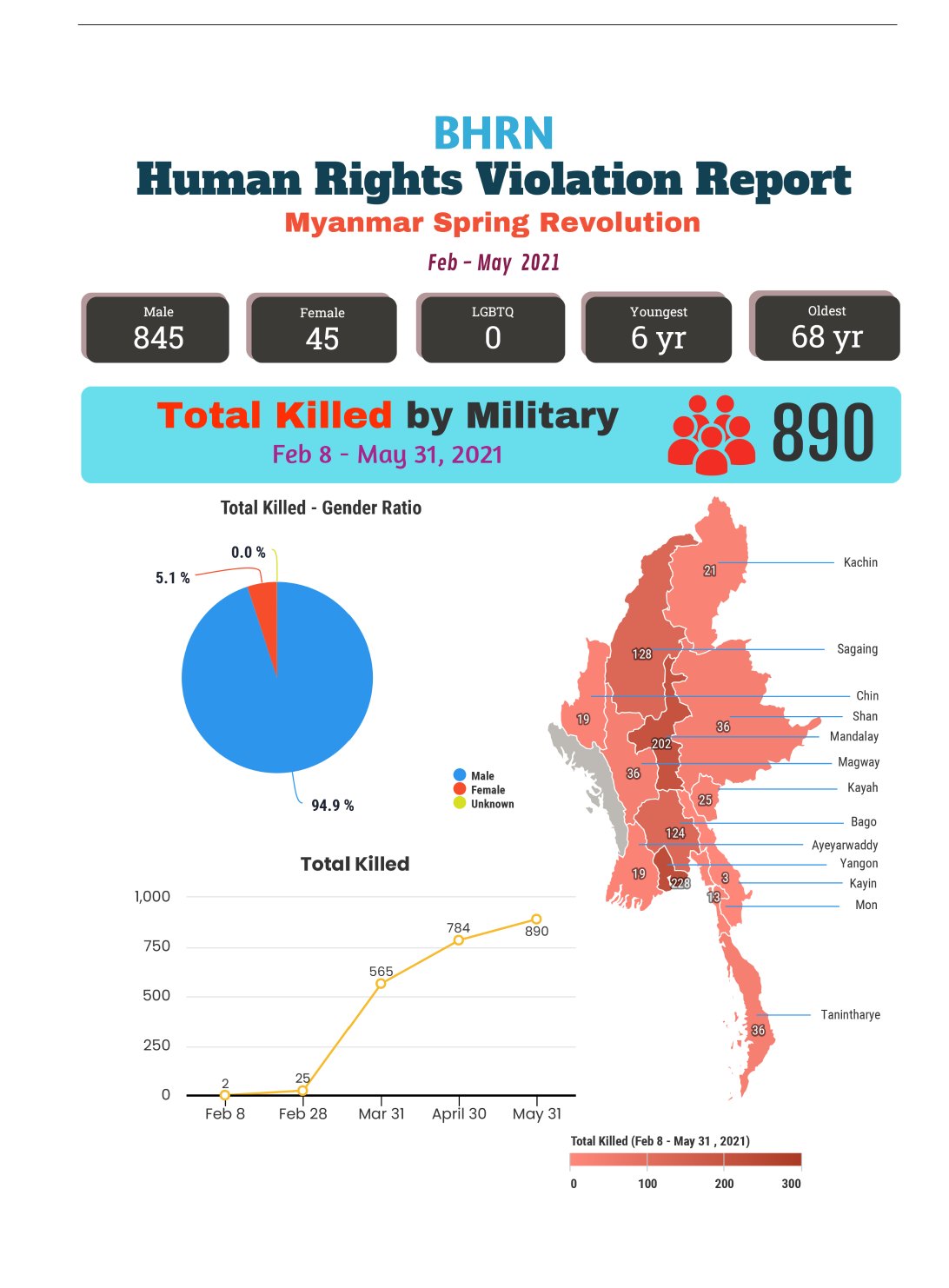
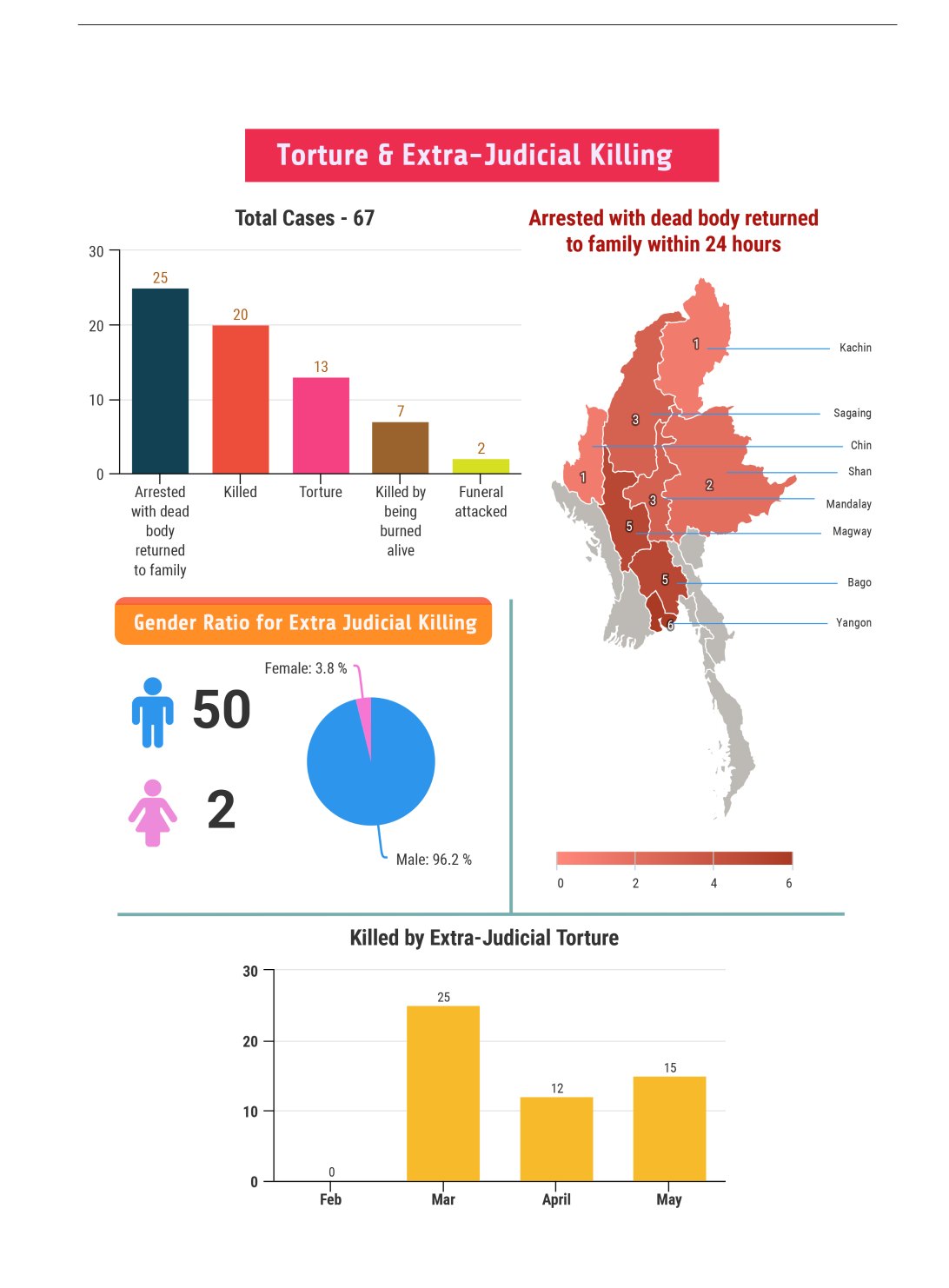
7Infographics: February – July 2021
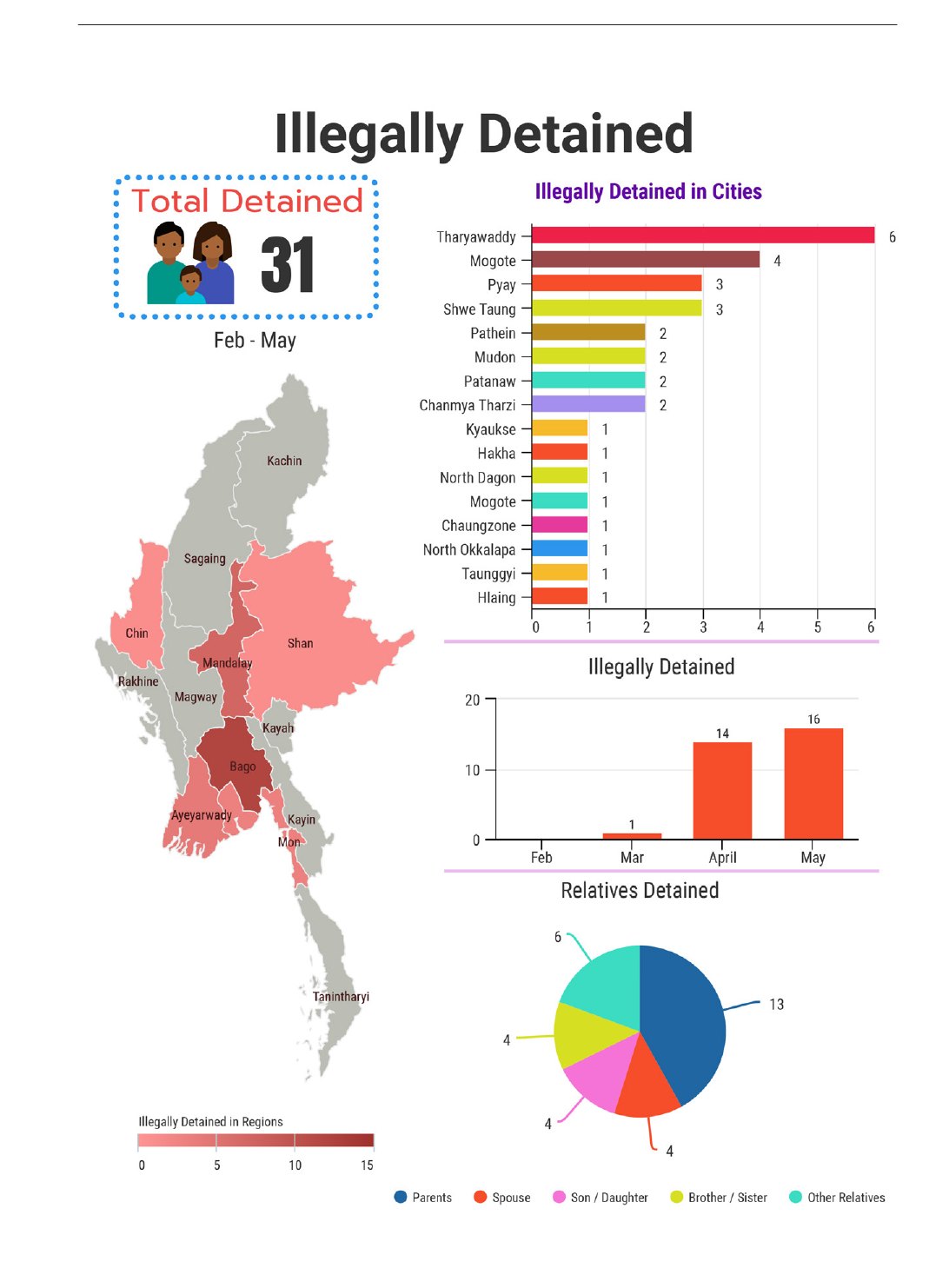
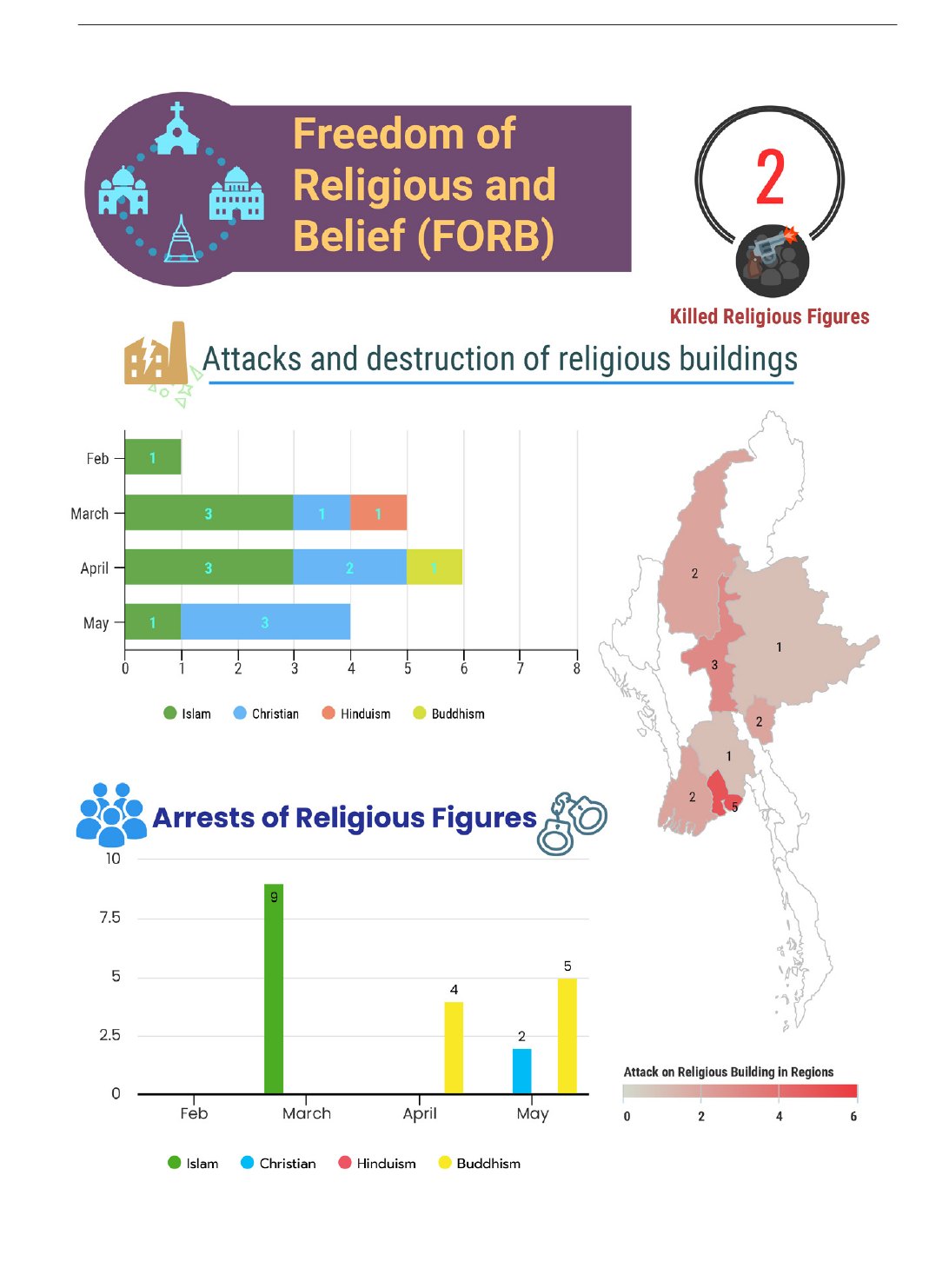
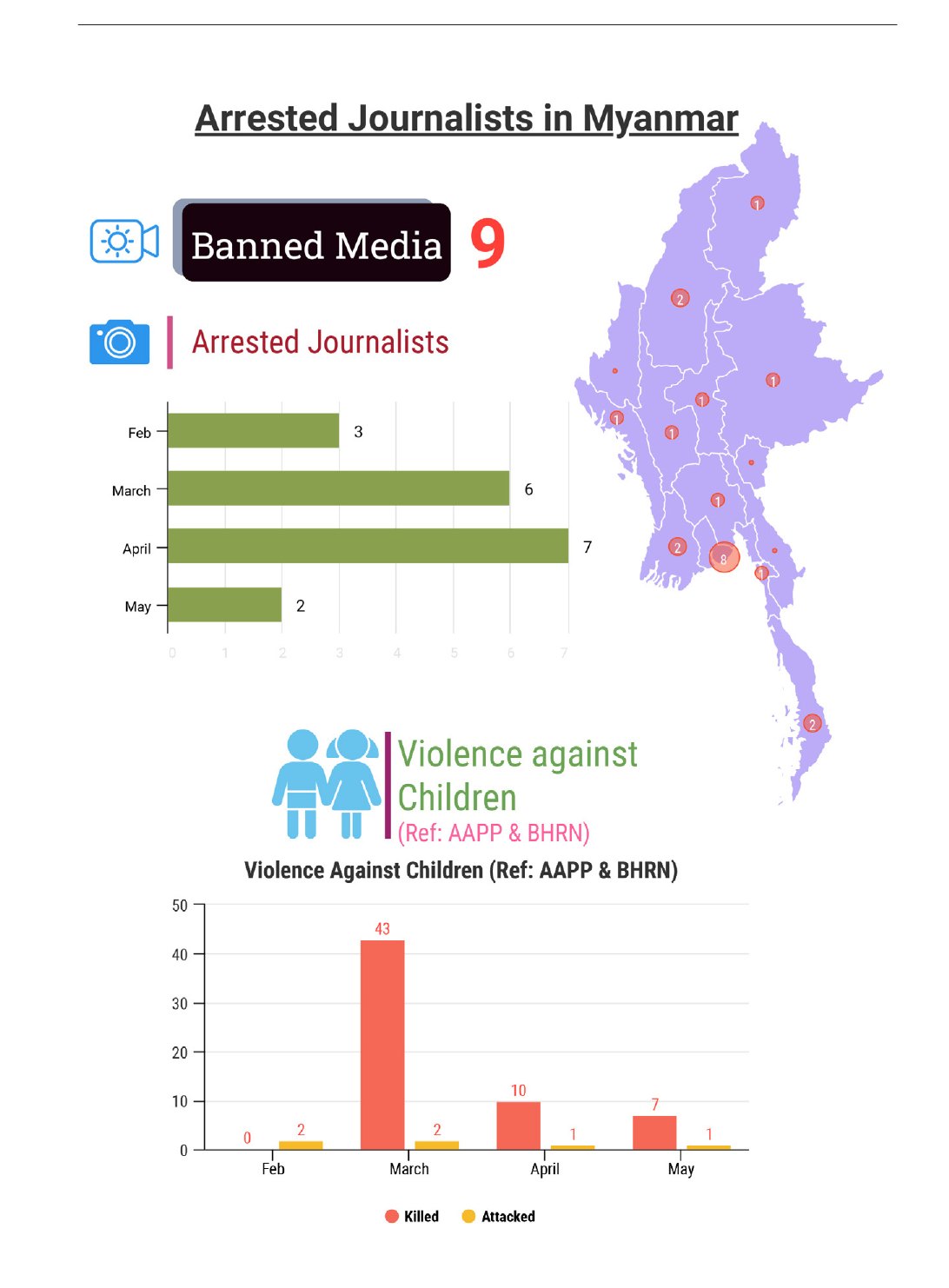
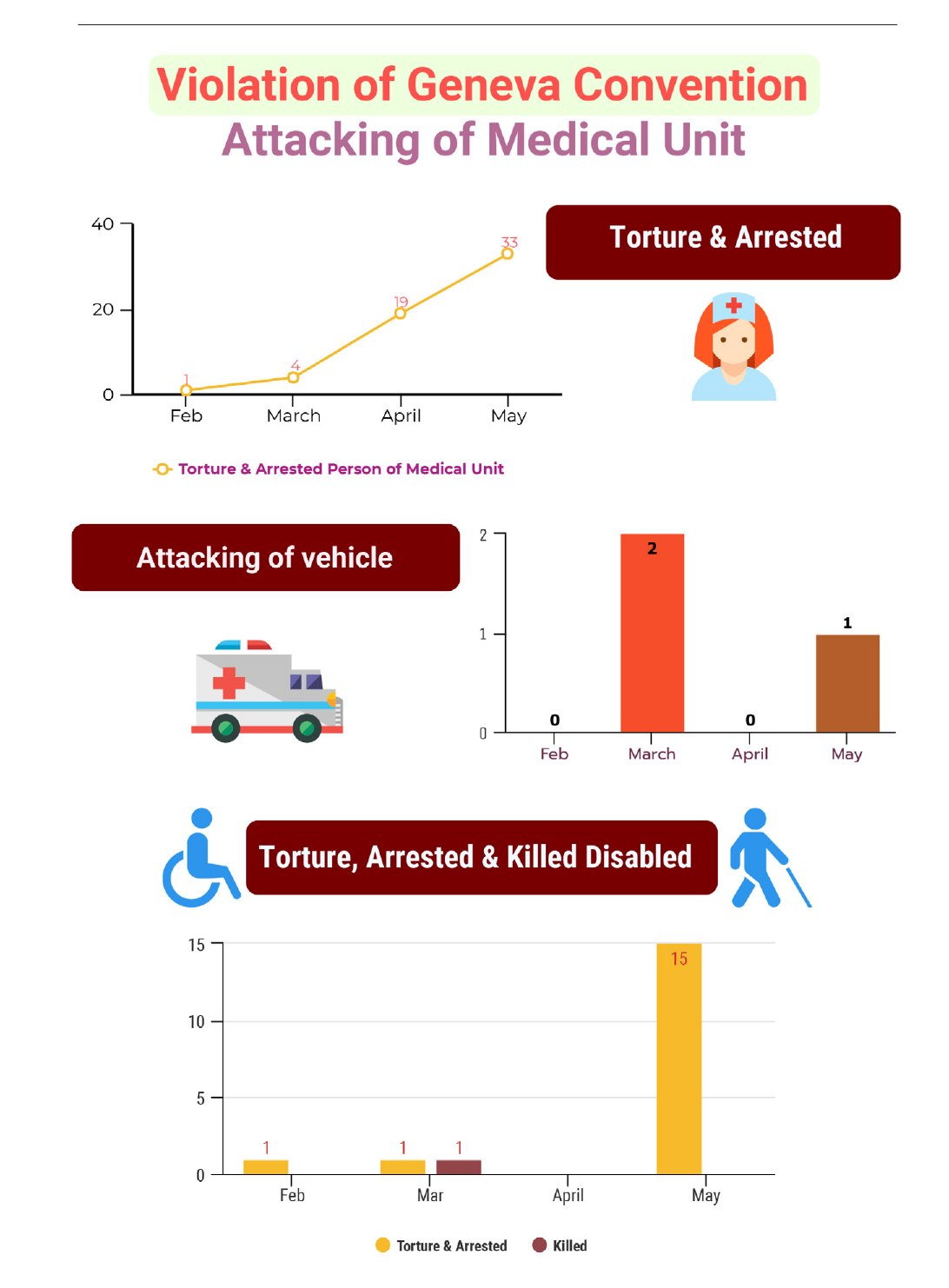
BHRN’s documentation of human rights violations during the Spring Revolution, February – July 2021. Tap a page to see it full size.
8Recommendations
1To States
- Do not recognize the junta as the legitimate representative of Myanmar.
- Reject any report of the UN's Credentials Committee that seeks to to accredit the Tatmadaw's representatives as the legitimate government of Myanmar.
- Set out a clear statement of the commitments and reforms that are needed from the NUG for it to receive recognition as the legitimate representative of Myanmar. If met by the NUG, recognize the NUG as the legitimate representative of Myanmar.
- States that have a seat on the UN Security Council should support a referral of the situation in Myanmar to the ICC or the creation of an ad hoc criminal tribunal. States should also seek to create opportunities for the High Commissioner for Human Rights and/or Special Rapporteur to brief Council members on their findings.
- States on the United Nations General Assembly’s 5th Committee should provide adequate financial support to the IIMM and resist efforts by other States to curtail the funding for that mechanism. States, in their national capacities, should provide adequate extrabugetary funding to ensure that the IIMM can operate effectively.
- States that are members of the UN Human Rights Council should ensure that the NUG is provided with an opportunity to respond to recommendations directed to Myanmar during the Universal Periodic Review when the Council adopts the report of Myanmar's UPR.
- Exercise universal and other forms of jurisdiction to investigate any individual from Myanmar – irrespective of position or rank – who may be responsible for committing genocide, war crimes, and crimes against humanity under international law.
- Impose economic sanctions on the Tatmadaw, including on its oil and gas revenues.
- Support and enforce a global arms embargo.
- Stop deferring to ASEAN and engage much more intensely and directly with the NUG, as well as take the lead in formulating an actionable plan that will return Myanmar to the path of democracy and which will hold the Tatmadaw accountable for its criminal conduct.
- Directly engage with the NUG in order to increase the delivery of humanitarian aid into Myanmar and ensure that it reaches the people of Myanmar and does not fall into the hands of the Tatmadaw.
- Border States and regional bodies, as well as donor States, should prioritize the immediate resumption of cross-border humanitarian aid and use any political influence they may have to insist that the Tatmadaw not prevent such aid from reaching those who need it.
2To United Nations Security Council
- Continue to closely monitor the situation in Myanmar and hold public meetings on the situation.
- Refer the situation in Myanmar to the ICC or create an ad hoc international criminal tribunal under Chapter VII of the UN Charter that includes within its temporal jurisdiction past crimes committed against ethnic and religious minority groups, including the Rohingya.
- Take all necessary measures under Chapter VII of the Charter.
- The United Kingdom, as a “penholder” on the situation in Myanmar on the Security Council, should introduce a comprehensive resolution that calls for: an immediate cessation of crimes and human rights abuses; refers the situation in Myanmar to the ICC or creates an ad hoc criminal tribunal; imposes an arms embargo, imposes targeted sanctions, and requires unfettered access for the provision of humanitarian aid into Myanmar.
- Should the United Kingdom fail to act, other States on the Security Council should introduce and begin negotiations on such a binding resolution without delay.
3To United Nations Human Rights Council
- Keep Myanmar on the agenda and continue to hold interactive dialogues and monitor the human rights situation, despite the lack of participation by a representative of Myanmar, and continue to adopt resolutions responding to developments in Myanmar.
- Provide the NUG with an opportunity to respond to recommendations directed to Myanmar during the Universal Periodic Review when the Council adopts the report of Myanmar's UPR.
4To High Commissioner on Human Rights
- Document and publicly report on the violations committed by the Tatamadaw, characterizing them as crimes against humanity.
5To United Nations General Assembly
- Recognise the NUG as the legitimate government of Myanmar once it has made the commitments laid out by States for such recognition.
- Continue to call on all UN member states to prevent the flow of arms to the Tatmadaw.
6To the Secretary General and Special Envoy on Myanmar
- Continue to express solidarity with the Burmese people, condemn the human rights violations committed by the Tatmadaw, and insist that the NUG should be represented in political discussions.
- Ensure that humanitarian aid provided by UN entities to Burma is closely monitored to prevent any diversion or effort by Tatmadaw-appointed authorities to prevent aid from reaching those aligned with the political opposition.
- Reflect the findings of the High Commissioner on Human Rights and the Special Rapporteur on human rights violations committed by the Tatmadaw in their briefings to the UNSC and other interactions with member states.
7To the National Unity Government
- Continue to cooperate with the IIMM, the ICJ, and the ICC.
- Clarify the procedural avenue that it intends to pursue with the ICC and consider publicly committing to ratifying the Rome Statute.
- Set out publicly and in detail the domestic reforms that it intends to undertake to strengthen the Burmese judicial institutions.
- Commit to the extradition of any officials sought for prosecution under universal jurisdiction procedures by another State.
- Further clarify its position with respect to the rights of the Rohingya ethnic minority, specifically regarding whether and how it intends to officially recognize their identity, restore their citizenship and other ethnic rights taken away over the past decades, and repeal discriminatory laws that target the Rohingya.
- Demonstrate its commitment to forging a truly representative and inclusive path forward for Myanmar and all Burmese people by including members of the Rohingya community, as well as other Muslim groups, with the NUG and appointing them to government positions.
- Continue to work with supportive States, even in if on an informal basis, to establish humanitarian aid routes in those areas where the NUG is able to operate outside of the Tatmadaw’s control.
Footnotes
- Erin Farrell Rosenberg is an attorney specialising in international criminal law (ICL) and reparations, having worked at the ICTY and the International Criminal Court. She is the former Senior Advisor for the Centre for the Prevention of Genocide at the United States Holocaust Memorial Museum, where she was the lead author for the report series, Practical Prevention: How the Genocide Convention’s Obligation to Prevent Applies to Burma . She is also an adjunct professor at the University of Cincinnati School of Law. She is a member of the Editorial Committee of the Journal of International Criminal Justice (JICJ) and the ABA Working Group on Crimes Against Humanity. ↩
- From 2009 to 2015, Stephen Rapp was the Ambassador-at-Large heading the Office of Global Criminal Justice in the US State Department. Prior to that, he served as Prosecutor of the Special Court for Sierra Leone, where he led the prosecution of former Liberian President Charles Taylor, and as Senior Trial Attorney and Chief of Prosecutions at the International Criminal Tribunal for Rwanda. He is currently a Senior Fellow at the United States Holocaust Memorial Museum’s Centre for Prevention of Genocide, and at Oxford University’s Center for Law, Ethics and Armed Conflict. He serves as Chair of the Commission for International Justice and Accountability (CIJA), a Senior Peace Fellow of the Public International Law and Policy Group, and on the boards of Physicians for Human Rights, the IBA Human Rights Institute, the ABA Rule of Law Initiative, Guernica37, and the Siracusa International Institute for Criminal Justice and Human Rights. ↩
- See United Nations Security Council, “Statement by the President of the Security Council”, S/PRST/2021/5, 10 March 2021, available at : https://undocs.org/S/PRST/2021/5 ; Media Note, “G7 Foreign Ministers’ Statement on Burma” 23 February 2021, available at : https://www.state.gov/g7-foreign-ministers-statement-on-burma/ . ↩
- See e.g. United Nations Human Rights Council, “Statement by Thomas H. Andrews UN Special Rapporteur on the Situation of Human Rights in Myanmar United Nations Human Rights Council”, 11 March 2021, stating that the Tatmadaw is “now likely engaging in crimes against humanity”. Available at : https://www.ohchr.org/EN/NewsEvents/Pages/ DisplayNews.aspx?NewsID=26884&LangID=E . ↩
- See e.g. Assistance Association for Political Prisoners (Burma), available at : https://aappb.org/ (last accessed 15 July 2021) . ↩
- See Vikram Nehru, “Myanmar’s Military Keeps Firm Grip on Democratic Transition”, 2 June 2015, available at : https://carnegieendowment.org/2015/06/02/myanmar-s-military-keeps-firm-grip-on-democratic-transition-pub-60288 . ↩
- Reuters, “Myanmar opposition demands vote re-run as Suu Kyi's NLD heads for victory”, 11 November 2020, available at : https://www.reuters.com/article/us-myanmar-election/myanmar-opposition-demands-vote-re-run-as-suu-kyis-nld-heads-for-victory-idUSKBN27R0UO . ↩
- Myanmar Now, “Domestic Elections Observers Urge All Parties to Accept Results of Vote,” January 30, 2021, available at : https://www.myanmar-now.org/en/news/domestic-election-observers-urge-all-parties-to-accept-result-of-vote . ↩
- See UN Human Rights Council, Report of the Special Rapporteur on the situation of human rights in Myanmar, Thomas H. Andrews, A/HRC/46/56, 4 March 2021, available at : https://www.ohchr.org/EN/HRBodies/HRC/RegularSessions/Session46/Documents/A_HRC_46_56.pdf ; The Diplomat, “Was Myanmar’s Coup Legal? And Does it Matter?”, 17 February 2021, available at : https://thediplomat.com/2021/02/was-myanmars-coup-legal-and-does-it-matter/ . ↩
- Al Jazeera, “In Pictures: Striking pans to protest Myanmar’s military coup”, 3 February 2021, available at : https://www.aljazeera.com/gallery/2021/2/3/in-pictures-striking-pans-in-myanmars-capital-to-protest-coup . ↩
- Tommy Walker, Voice of America, “How Myanmar's Civil Disobedience Movement Is Pushing Back Against the Coup”, 27 February 2021, available at : https://www.voanews.com/east-asia-pacific/how-myanmars-civil-disobedience-movement-pushing-back-against-coup . ↩
- The Irrawaddy, “Amid Coup, Myanmar's NLD Lawmakers Form Committee to Serve as Legitimate Parliament, 8 February 2021, available at : https://www.irrawaddy.com/news/burma/amid-coup-myanmars-nld-lawmakers-form-committee-serve-legitimate-parliament.html . ↩
- Reuters, “Opponents of Myanmar coup form unity government, aim for ‘federal democracy’” , 16 April 2021, available at : https://www.reuters.com/world/asia-pacific/opponents-myanmar-coup-announce-unity-government-2021-04-16/ . ↩
- UN News, “Myanmar: From political crisis, to ‘multi-dimensional human rights catastrophe’ – Bachelet”, 6 July 2021, available at : https://news.un.org/en/story/2021/07/1095392 ↩
- Al Jazeera, “U.N. says 100,000 flee fighting in Myanmar border state”, 8 June 2021, available at : https://www.reuters.com/world/china/myanmar-junta-defends-response-crisis-amid-southeast-asian-criticism-2021-06-08/ . ↩
- Press Release, BHRN, 16 July 2021, available at : https://www.bhrn.org.uk/en/press-release/1175-international-community-must-help-burma-s-covid-19-crisis.html . ↩
- UN Office of the High Commissioner on Human Rights, “Myanmar: UN expert warns of “perfect storm” over COVID, calls for urgent international help”, 14 July 2021, available at : https://www.ohchr.org/EN/NewsEvents/Pages/DisplayNews.aspx?NewsID=27307&LangID=E . ↩
- Ibid. See also Myanmar Now, “Myanmar unable to import badly needed medical supplies via border crossings with China ”, 14 July 2021, available at : https://www.myanmar-now.org/en/news/myanmar-unable-to-import-badly-needed-medical-supplies-via-border-crossings-with-china ↩
- Press Release, Global Centre for the Responsibility to Protect, “Atrocity Alert No. 261: Myanmar (Burma), Nigeria and Israel and the Occupied Palestinian Territories”, 15 July 2021, available at : https://reliefweb.int/report/myanmar/atrocity-alert-no-261-myanmar-burma-nigeria-and-israel-and-occupied-palestinian . ↩
- Daniel Hurst, “Australia should target Myanmar ‘gang leader’ for sanctions, UN expert says”, 14 April 2021, available at : https://www.theguardian.com/world/2021/apr/15/australia-should-target-myanmar-gang-leader-for-sanctions-un-expert-says . ↩
- Rome Statute of the International Criminal Court, Preamble, providing that: “ Mindful that during this century millions of children, women and men have been victims of unimaginable atrocities that deeply shock the conscience of humanity”. ↩
- The Rome Statute has been ratified by 123 State Parties. ↩
- See e.g. “Report of the detailed findings of the Independent International Fact-Finding Mission on Myanmar”, A/HRC/39/CRP.2, 17 September 2018, paras 43, 64 (FFM 2018 Report), available at: https://undocs.org/A/HRC/39/CRP.2 ; International Law Commission, Draft articles on Prevention and Punishment of Crimes Against Humanity, with commentaries, A/ 74/10 (2019), pp. 24-25 (ILC Draft CAH Convention with Commentaries). Available at : https://legal.un.org/ilc/texts/instruments/english/commentaries/7_7_2019.pdf . The preamble to the ILC Draft CAH Convention also states that: “ Recalling also that the prohibition of crimes against humanity is a peremptory norm of general international law ( jus cogens ).” See also United Nations Office on Genocide Prevention and the Responsibility to Protect, stating that: “Crimes against humanity have not yet been codified in a dedicated treaty of international law, unlike genocide and war crimes, although there are efforts to do so. Despite this, the prohibition of crimes against humanity, similar to the prohibition of genocide, has been considered a peremptory norm of international law, from which no derogation is permitted and which is applicable to all States.”. Available at : https://www.un.org/en/genocideprevention/crimes-against-humanity.shtml . ↩
- See FFM 2018 Report, para. 64 (internal footnotes omitted). ↩
- UN General Assembly, Universal Declaration of Human Rights , 10 December 1948, 217 A (III) (UDHR), art. 3; UN General Assembly, International Covenant on Civil and Political Rights , 16 December 1966 (ICCPR), art. 6(1); UN General Assembly, Convention on the Rights of the Child , 20 November 1989 (CRC), art. 6. ↩
- See UDHR, art. 5;, arts. 7 and 10; UN General Assembly, Convention Against Torture and Other Cruel, Inhuman or Degrading Treatment or Punishment , 10 December 1984 (CAT), CRC, art. 37(a). ↩
- UDHR, art. 31.1; ICCPR, art. 12. ↩
- UDHR, art. 25; CRC, art. 6. ↩
- BHRN has documented a number of attacks on members of the media at protests. For example, on 27 February 2021, the Monywa Gazette news agency CEO and editor-in-chief was beaten and arrested while presenting the news. On 9 March, the headquarters of Mizzima News in Yangon was raided by the military and its broadcasts were suspended. ↩
- Myanmar acceded to the CRC on 15 July 1991. See https://tbinternet.ohchr.org/_layouts/15/TreatyBodyExternal/Treaty.aspx?CountryID=119&Lang=EN for Myanmar’s ratification status of international human rights conventions and treaties. ↩
- Blog post, Save the Children, “KILLINGS, VIOLENCE, AND DETENTION: MYANMAR IS NO PLACE FOR CHILDREN”, 1 April 2021, available at : https://www.savethechildren.net/blog/killings-violence-and-detention-myanmar-no-place-children . ↩
- See FFM 2018 Report, para. 10. ↩
- It should be reiterated that, while Myanmar is not presently a State Party to the Rome Statute, it is bound by the rules of customary international law that prohibit crimes against humanity. To the extent that the legal definition in article 7 of the Rome Statute departs from customary international law, it is generally considered more restrictive . ↩
- Press Release, OHCHR, “Myanmar: UN human rights expert issues report and urges decisive, unified action to put an end to brutality”, 4 March 2021, available at : https://www.ohchr.org/EN/NewsEvents/Pages/DisplayNews.aspx?NewsID=26845&LangID=E . ↩
- See UN Human Rights Council, “Compilation of all recommendations made by the Independent International Fact-Finding Mission on Myanmar, to the Government of Myanmar, armed organizations, the UN Security Council, Member States, UN agencies, the business community and others”, A/HRC/42/CRP.6, 16 September 2019, para. 82. Available at : https://www.ohchr.org/Documents/HRBodies/HRCouncil/FFM-Myanmar/20190916/A_HRC_42_CRP.6.pdf . ↩
- See for a similar explanation FFM 2018 Report, para. 1442. ↩
- ICC Elements of Crimes, Article 7, Introduction, para. 3. ↩
- See The Prosecutor v. Bosco Ntaganda , Public redacted version of Judgment on the appeals of Mr Bosco Ntaganda and the Prosecutor against the decision of Trial Chamber VI of 8 July 2019 entitled ‘Judgment’, 30 March 2021, ICC-01/04-02/06-2666-Red, paras 418, 422-424, in which the Appeals Chamber clarified that the civilian population need not be the “primary” objective, but rather that the attack need only be directed against the civilian population. In this regard, an attack as a crime against humanity can occur even in the context of a military operation with a legitimate objective. ↩
- Ibid. ↩
- The Prosecutor v. Dominic Ongwen , Trial Judgment, 4 February 2021, ICC-02/04-01/15- 1762-Red ( Ongwen Trial Judgment), para. 2678. ↩
- Ongwen Trial Judgment, para. 2679. See also The Prosecutor v. Bosco Ntaganda , Judgment, 8 July 2019, ICC-01/04-02/06-2359 ( Ntaganda Trial Judgment), para. 674. ↩
- See , for an overview of the jurisprudence on the contextual element of the ‘widespread or systematic’ nature of the attack, ILC Draft CAH Convention with Commentaries, pp. 31-34 (internal footnotes omitted). ↩
- Ongwen Trial Judgment, para. 2682. ↩
- ICC Elements of Crimes, art. 7 (1) (a) (1); Ntaganda Trial Judgment, para. 859. ↩
- Ntaganda Trial Judgment, para. 862. ↩
- ICC Elements of Crimes, art. 7 (1) (e). ↩
- ICTY, Prosecutor v Krajisnik , IT-00-39-T, Judgment and Sentence, 27 September 2006, para. 752. ↩
- ICTR, Prosecutor v. Ntagerura et al ., ICTR-99-46-T, Judgment, 25 February 2004, para. 702. ↩
- Supra fn. 4. ↩
- Rome Statute, art. 7 (2) (i). See for a discussion of the law governing the crime of enforced disappearance Situation in the Republic of Burundi , Public Redacted Version of “Decision Pursuant to Article 15 of the Rome Statute on the Authorization of an Investigation into the Situation in the Republic of Burundi”, ICC-01/17-X-9-US-Exp, 25 October 2017, 9 November 2017, ICC-01/17-9-Red ( Burundi Article 15 Decision), paras 117-121. ↩
- Burundi Article 15 Decision, para. 118, holding that: “The crime also includes the scenario in which a victim, initially arrested and detained lawfully, may be ‘disappeared’ in custody”. ↩
- See Burundi Article 15 Decision, para. 120, noting that, with regard to the “prolonged period of time” threshold that: “A period of several months […] certainly fulfils that requirement.” Arguably, weeks would also meet this threshold, but the inquiry is fact-specific. ↩
- See Amnesty International, “What We do- Enforced Disappearance”, available at : https://www.amnesty.org/en/what-we-do/disappearances/ . ↩
- Ibid. ↩
- BHRN notes that the number of persons actually released by the Tatmadaw is disputed, with researchers suggesting that the real number is much lower than that claimed publicly by the Tatmadaw. See Press Release, AAPP, SITUATION UPDATE ON 30 JUNE PRISON RELEASES, 15 July 2021, available at : https://progressivevoicemyanmar.org/2021/07/15/situation-update-on-30-june-prison-releases/ . ↩
- See Burundi Article 15 Decision, para. 121, holding that: “The crime of enforced disappearance is considered a continuous crime as long as the perpetrators continue to conceal the fate and whereabouts of the person or persons who have disappeared and these facts remain unclarified.” ↩
- Torture as a crime against humanity is different from torture under the Convention Against Torture (CAT) and torture as a war crime in that there is no requirement to prove a specific purpose of the torture. Compare in this regard, ICC Elements of Crimes, art. 7 (1) (f), fn. 14, stating that “[i]t is understood that no specific purpose need be proved for this crime” with art. 8 (2) (a) (ii) -1, element 2: “the perpetrator inflicted the pain or suffering for such purposes as: obtaining information or a confession, punishment, intimidation or coercion or for any reason based on discrimination of any kind” and CAT, art. 1, defining “torture” as when committed “for such purposes as obtaining from him or a third person information or a confession, punishing him for an act he or a third person has committed or is suspected of having committed, or intimidating or coercing him or a third person, or for any reason based on discrimination of any kind […]”. ↩
- Rome Statute, art. 7 (2) (e). ↩
- Ibid. ↩
- Examples of this crime come from the ICC, the International Criminal Tribunal for the former Yugoslavia (ICTY), the International Criminal Tribunal for Rwanda (ICTR), and the Special Court for Sierra Leone (SCSL). For example, because the ICTY’s statute only listed deportation as a crime against humanity, the Kupreškić Trial Chamber held that forcible transfer was a crime against humanity as other inhumane acts, finding that the act was of a similar nature and gravity to the listed crime of deportation. At the ICTR, rape was listed as a crime against humanity, but not other acts of sexual violence. The ICTR Trial Chamber reasoned that sexual violence could be charged as ‘other inhumane acts’ due to its similar character to the listed crime of rape. In the Brima et al. and Sesay et al. cases, the SCSL Appeals Chamber upheld convictions for 'forced marriage' as a crime against humanity of 'other inhumane acts’. Similarly, in the Ongwen case, the ICC Trial Chamber convicted Mr Ongwen for forced marriages as a crime against humanity of other inhumane acts. See Ongwen Trial Judgment, paras 2741-2751, p. 1073. ↩
- Rome Statute, art. 7 (1) (h). ↩
- See ILC Draft CAH Convention with Commentaries, p. 44. ↩
- Krajišnik Appeals Judgment, paras 388-391. See also ICC, Situation in the People’s Republic of Bangladesh/Republic of the Union of Myanmar, Decision Pursuant to Article 15 of the Rome Statute on the Authorisation of an Investigation into the Situation in the People’s Republic of Bangladesh/Republic of the Union of Myanmar, 14 November 2019, ICC-01/19- 27. ↩
- It is for this reason, for example, that pillaging is a war crime, but not a crime against humanity. ↩
- See Appeals Chamber, The Prosecutor v. Tihomir Blaskic , Judgement, 29 July 2004, IT-95- 14-A, paras 148-149. However cf. Appeals Chamber, The Prosecutor v. Jean-Pierre Bemba Gombo, Separate Opinion of Judge Van den Wyngaert and Judge Morrison, 8 June 2018, ICC-01/05-01/08-3636-Anx2, para. 63, in which in the context of the crime against humanity of ‘other inhumane acts’, the two judges expressed the view that “property crimes are excluded from the purview of crimes against humanity”. The position of the Prosecutor, as argued in Bemba , is that at least deprivation of property which causes great suffering would qualify. In the context of persecution, it is arguable that the threshold is even lower still— especially if it is property of a symbolic nature, such as cultural/religious objects. ↩
- See Reuters, “Myanmar security forces kill over 100 protesters in 'horrifying' day of bloodshed”, 26 March 2021, available at : https://www.reuters.com/article/uk-myanmar-politics/myanmar-security-forces-kill-over-100-protesters-in-horrifying-day-of-bloodshed-idUSKBN2BJ02H . ↩
- Irrawaddy, “Myanmar Regime Troops Ordered to ‘Annihilate’ Protesters, Internal Memos Show”, 21 April 2021, available at : https://www.irrawaddy.com/news/burma/myanmar-regime-troops-ordered-annihilate-protesters-internal-memos-show.html . ↩
- See for the full text of the NUG’s position paper Facebook post, 3 June 2021, available at : https://twitter.com/tunkhin80/status/1400495288066969600?s=20 ↩
- The IIMM’s mandate from the United Nations Human Rights Council is to collect and analyze evidence of “the most serious international crimes and violations of international law committed in Myanmar since 2011” and to build case files to facilitate criminal proceedings in national, regional or international courts. See HRC, Resolution 39/2, adopted 27 September 2018. See also General Assembly, Resolution 73/264, 22 December 2018. ↩
- See https://www.facebook.com/DrSasa22222/photos/a.140520717538794/292756138981917/ , 9 April 2021 at 9.57. ↩
- The International Court of Justice is currently considering a case, which was instituted on 11 November 2019 by The Gambia against Myanmar for violating its obligations under the 1948 Convention on the Prevention and Punishment of the Crime of Genocide with respect to the Rohingya. See Application of the Convention on the Prevention and Punishment of the Crime of Genocide (The Gambia v Myanmar) , Application Instituting Proceedings and Request for Provisional Measures. ↩
- Press Statement, National Unity Government, (1/2021). ↩
- See Article 445 of the 2008 constitution. ↩
- Reuters, “Factbox: Sanctions imposed against Myanmar’s generals since they seized power”, 22 March 2021, available at : https://www.reuters.com/article/us-myanmar-politics-sanctions-factbox/factbox-sanctions-imposed-against-myanmars-generals-since-they-seized-power-idUSKBN2BE2PY . See also US Department of State, Burma Sanctions, available at: https://www.state.gov/burma-sanctions/ . ↩
- UN Human Rights Council, Statement by Thomas H. Andrews UN Special Rapporteur on the Situation of Human Rights in Myanmar, 7 July 2021, available at : https://www.ohchr.org/EN/NewsEvents/Pages/DisplayNews.aspx?NewsID=27283&LangID=E . ↩
- See UNSG, Statement attributable to the Spokesperson for the Secretary-General - on Myanmar, 11 May 2021, available at : https://www.un.org/sg/en/content/statement-attributable-the-spokesperson-for-the-secretary-general-myanmar-0 ; ↩
- UNSG, Statement attributable to the Spokesperson for the Secretary-General - on Myanmar, 27 March 2021, available at : https://www.un.org/sg/en/content/statement%C2%A0attributable-the-spokesperson-for-the%C2%A0secretary-general-myanmar%C2%A0 . ↩
- See Edith Lederer, Associated Press, “UN official: Myanmar people want UN sanctions, peacekeepers”, 20 March 2021, available at https://apnews.com/article/global-trade-myanmar-antonio-guterres-united-nations-asia-pacific-ff8fdf32220904941181c5e145704385 . ↩
- UN Secretary General, Note to Correspondents: UN Special Representative Patten expresses grave concern over reports of sexual violence in detention setting in Myanmar, 25 June 2021, available at : https://www.un.org/sg/en/content/sg/note-correspondents/2021-06-25/note-correspondents-un-special-representative-patten-expresses-grave-concern-over-reports-of-sexual-violence-detention-setting-myanmar . ↩
- UN News, Myanmar: From political crisis, to ‘multi-dimensional human rights catastrophe’ – Bachelet, 6 July 2021, available at : https://news.un.org/en/story/2021/07/1095392 . ↩
- UN Secretary General, Note to Correspondents: Joint Statement by UN Special Adviser on the Prevention of Genocide and UN High Commissioner for Human Rights - on Myanmar, 28 March 2021, available at : https://www.un.org/sg/en/content/note-correspondents-joint-statement-un-special-adviser-the-prevention-of-genocide-and-un-high-commissioner-for-human-rights-myanmar ↩
- See Press Release, OHCHR, “Myanmar: UN human rights expert issues report and urges decisive, unified action to put an end to brutality”, 4 March 2021, available at : https://www.ohchr.org/EN/NewsEvents/Pages/DisplayNews.aspx?NewsID=26845&LangID=E . in his report, UN Special Rapporteur on the situation of human rights in Myanmar, Tom Andrews, called for the UN Security Council to make “a referral to the International Criminal Court to investigate and prosecute atrocities committed since the coup on 1 February and those committed against ethnic groups in years prior ” (emphasis added). ↩
- See Press Release, UN General Assembly, “General Assembly Reappoints Secretary- General to Second Five-Year Term, Adopting Resolution Condemning Lethal Violence by Myanmar’s Armed Forces”, 18 June 2021, available at : https://www.un.org/press/en/2021/ ga12339.doc.htm . ↩
- See , for an explanation of the “penholder” system, Research Report, Security Council Report, 2018 No. 3, 21 December 2018, available at https://www.securitycouncilreport.org/research-reports/the-penholder-system.php ↩
- See in this regard UN Human Rights Council, Decision on Holding Interactive Dialogues with the High Commissioner and the Special Rapporteur on their Oral Presentations on Myanmar at the Forty-seventh Session of the Council, 1 July 2021, available at : https://www.ohchr.org/EN/HRBodies/HRC/Pages/NewsDetail.aspx?NewsID=27252&LangID=E . ↩
About BHRN
BHRN is funded by the National Endowment for Democracy (NED), Unitarian Universalist Service Committee (UUSC), and private individuals. BHRN is based in London and operates across Burma working for human rights, the protection of minorities and religious freedom in the region.
Freedom and Human Rights for All from Birth
www.bhrn.org.uk · facebook.com/bhrnuk · @bhrnuk


