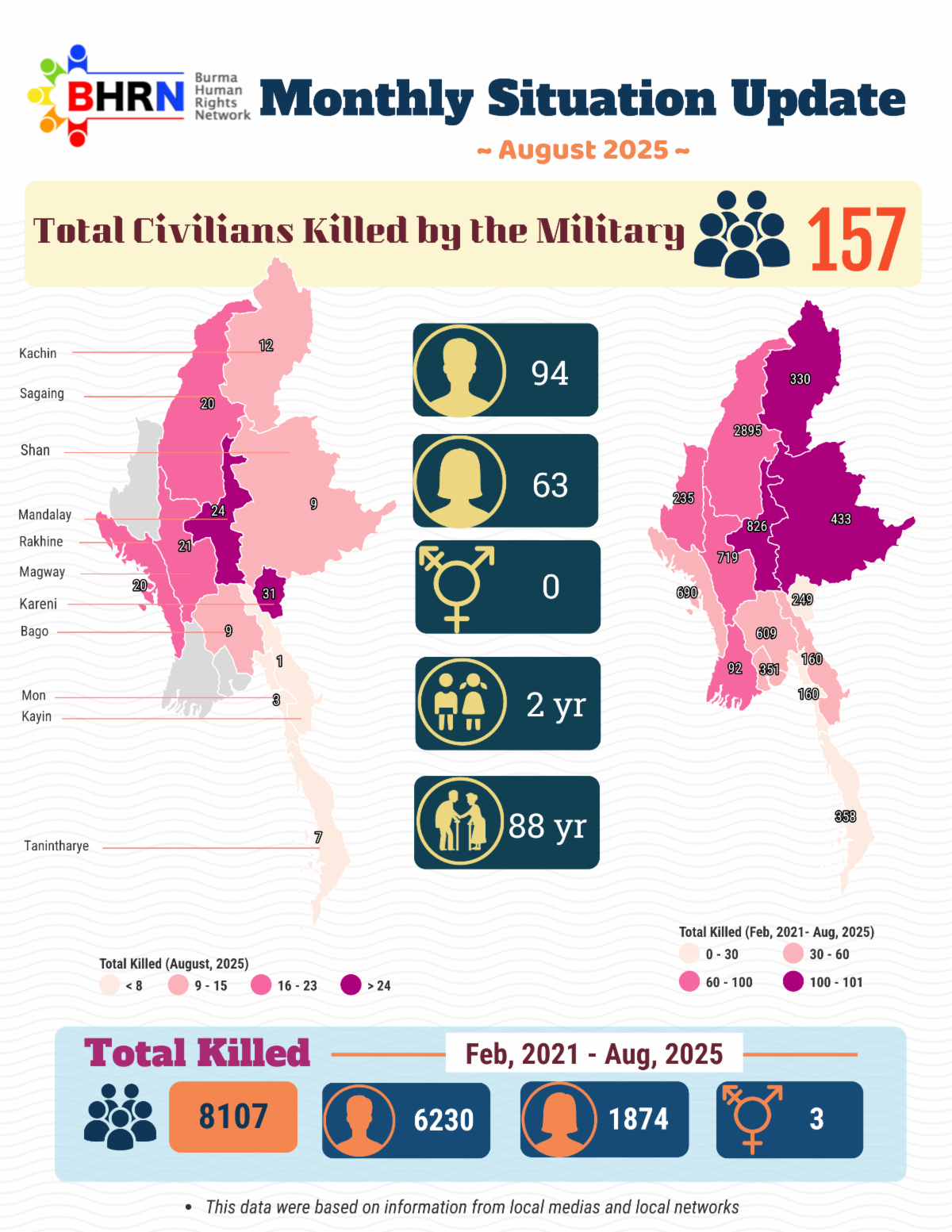
In August, the junta reorganized its rule under the SSPC while widening coercive legislation and surveillance, tightening control over civic space and election preparations. The National Defence and Security Council dissolved the SAC and installed the SSPC under Min Aung Hlaing, then declared a new emergency and martial law in 63 townships. The junta-run Union Election Commission announced a first phase of polling on 28 December 2025. In parallel, the junta activated the Election Protection Law, adopted a Military Secrets law carrying life imprisonment or the death penalty, brought the Cybersecurity Law into force, and suspended key privacy protections. Enforcement in Mandalay through phone searches and PSMS identity screening showed how these measures operate in practice. Together they expand detention, surveillance, and censorship powers and create conditions that cannot support a credible vote.
Attacks by MAF repeatedly struck civilians and protected sites across multiple states and regions. Airstrikes hit a school in Hpasawng in Karenni State, a monastery sheltering displaced people in Mogoke with 21 killed and further bombs reported on 17 August, a second monastery in Mogok on 15 August with additional deaths and injuries, and populated areas in Mawchi with reports ranging from at least five children killed to at least 23 civilians killed. In Sagaing Region, an airstrike on a monastery in Tabayin killed at least six people and a paramotor strike on a home in Salingyi killed a woman and seriously injured two relatives. Strikes on IDP sites in Madaya and in Mrauk U were also reported, with 12 people killed in Mrauk U and around twenty injured. Ground operations included raids and the burning of homes and villages in Mandalay, Rakhine, Magway, and Southern Shan.
In August, MAF forces carried out arbitrary detentions and actions that targeted religious communities. In Hakha, MAF detained groups of youths on 3 and 10 August, including several under 18, amid heightened fear among residents and displaced people sheltering in the town. After retaking Nawnghkio, troops arrested two religious leaders and sealed a mosque, a Hindu temple, and at least twenty homes. A drone strike on Obo Prison killed 21 prisoners, including 17 political prisoners, and the perpetrator remains unknown. A raid in Moe Shwe Gu in Tanintharyi displaced hundreds of civilians.
International responses focused on accountability and leverage. The International Trade Union Confederation urged non recognition of the planned elections and called for measures under ILO Article 33. The Independent Investigative Mechanism for Myanmar reported systematic torture and sexual violence in detention and advances in identifying individual perpetrators, while warning of funding constraints. At the same time, a lobbying contract in Washington sought to rebuild relations, and gas revenues routed through MOGE, including via the Yadana project operated by PTT, remained a critical source of hard currency. Regionally, funding cuts left more than one hundred thousand refugees from Burma in Thailand without essential food and primary health care, and Bangladesh convened a dialogue in Cox’s Bazar to elevate Rohingya perspectives ahead of United Nations discussions.
Despite a river flotilla of reinforcements reaching Bhamo, resistance forces recorded gains that underscore the fluid security landscape. KIA led units retook or captured positions in Kachin State, including Light Infantry Battalion 236, and recaptured Shanni Nationalities Army camps near Indawgyi. An NUG led coalition overran a junta camp in Mawlaik. These developments, combined with expanded martial law and the junta’s legal measures, point to escalating risks to civilians, shrinking space for independent monitors and humanitarian actors, and a political environment that rewards coercion rather than consent ahead of the announced vote.
Amid all these developments, Muslims across Myanmar continued to face oppression, and the junta denied permission for the reconstruction of mosques that were destroyed in the March earthquake in central Myanmar. The junta continued to use its “four cuts” strategy in its ongoing operation in Tanintharyi Region, where the local population, including Pashu Muslims (Malays) who live in the remotest parts of the region. As a result, residents are facing severe shortages of food and essential medical supplies, with humanitarian access being restricted.