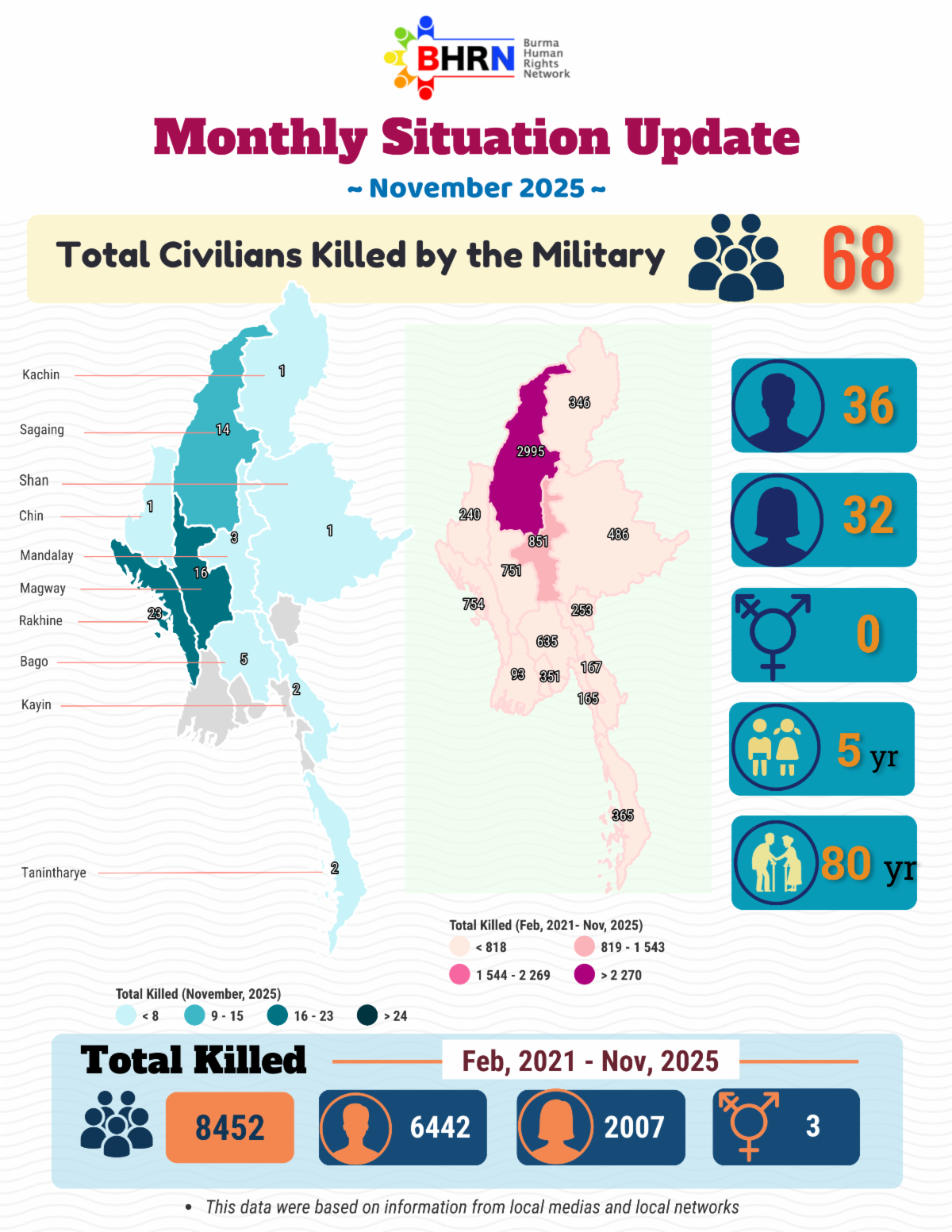
As the junta accelerates preparations for its staged elections, the human rights situation across Myanmar continued to deteriorate this month. November was marked by intensified military violence targeting civilians, escalating persecution of Muslim minorities, and aggressive use of surveillance, arrest, and legal repression to eliminate dissent. The junta carried out repeated airstrikes and artillery attacks on displacement sites, schools, hospitals, and religious infrastructure. In Rakhine State, airstrikes and forced recruitment campaigns targeted Rohingya and other civilians, while new restrictions imposed by the Arakan Army mirrored the discriminatory practices of past military regimes. Arbitrary detentions, torture, and extrajudicial executions persisted across the country, alongside a documented case of gang rape and murder by regime soldiers and a notable rise in attacks on religious institutions.
Resistance forces pushed forward on multiple fronts, seizing strategic ground and disrupting key junta supply chains. The capture of Maw Taung, a major border trade post with Thailand, dealt a blow to the regime’s cross-border revenue and control over Tanintharyi. Chin resistance groups retook Mount Kennedy outpost, while joint offensives across Sagaing, Mandalay, and Magway left hundreds of junta soldiers dead or captured. But even as the resistance made gains, the junta retaliated with increasing brutality, bombing hospitals and shelters, torching villages, and stepping up forced recruitment and arbitrary detention.
International responses to the junta's staged elections diverged sharply in November. The European Parliament rejected the elections outright and recognized the NUG and CRPH as legitimate representatives, explicitly linking any credible political settlement to protection for minorities and reform of the discriminatory 1982 Citizenship Law. U.S. lawmakers held a major congressional hearing and issued bipartisan statements condemning the vote as illegitimate and Chinese-backed. ASEAN maintained its characteristic ambiguity, reiterating the Five-Point Consensus while establishing that "cessation of violence and inclusive political dialogue must precede elections", conditions the junta continues to violate, and declined to send observers. Yet governments simultaneously undermined these positions through contradictory actions. The U.S. terminated Temporary Protected Status for nearly 4,000 Burmese nationals despite ongoing violence and persecution. Malaysia prosecuted Rohingya shipwreck survivors while announcing refugee registration plans. Bangladesh detained over 500 Rohingya attempting to flee by sea. Swedish pension funds hold over $484 million in companies supplying the junta with arms, surveillance technology, and energy revenues. Gas operations in British Overseas Territories continue generating hundreds of millions for regime-controlled entities despite UK sanctions. Without coordinated enforcement, governments will give the junta what it needs, international cover to claim its sham elections are legitimate, while simultaneously closing protection pathways for those fleeing the regime's atrocities.