
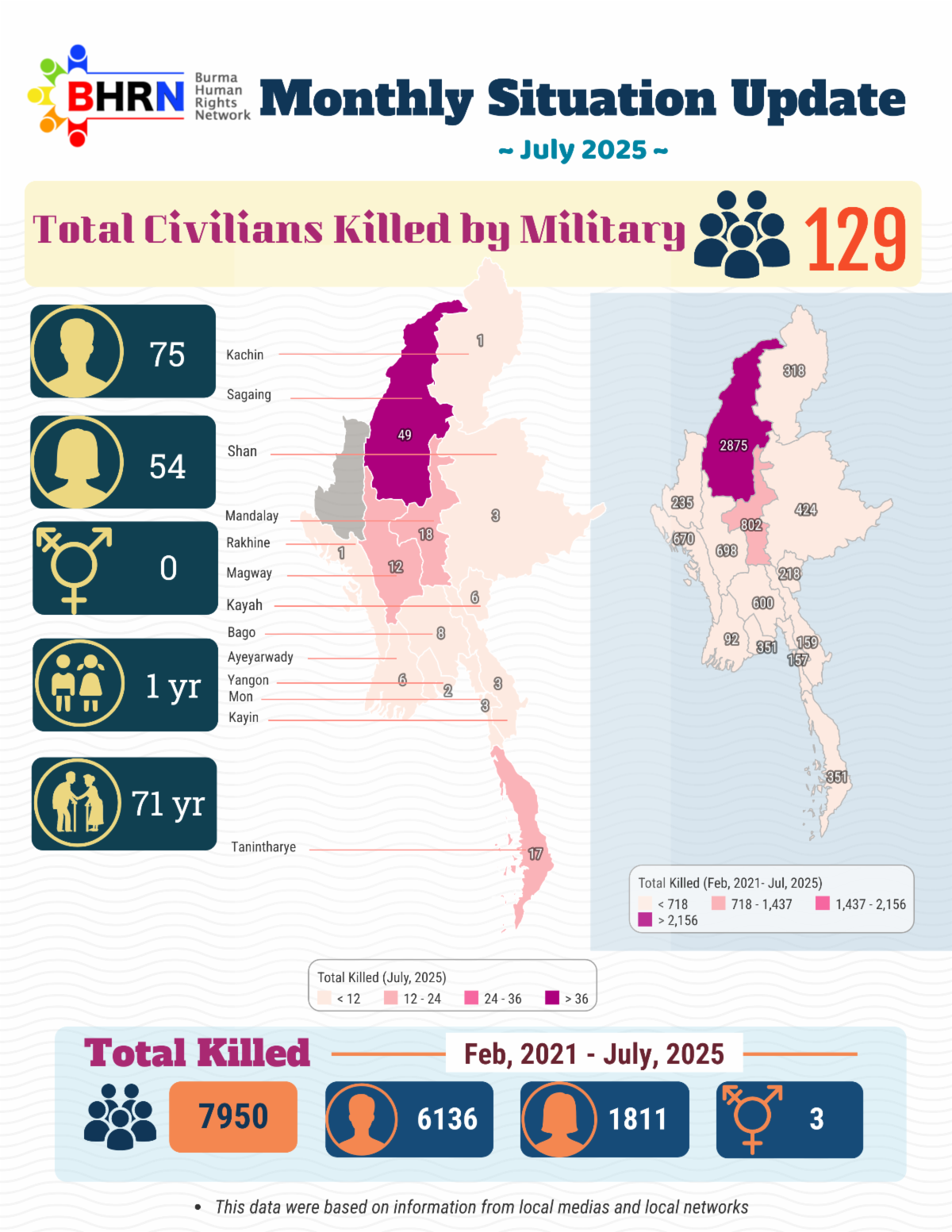
In July 2025, Myanmar’s military junta escalated repression through new laws aimed at silencing dissent and tightening control over civic space. The Cybersecurity Law, now in force, grants the authorities broad powers to monitor, censor, and criminalize online activity, including extraterritorially. The newly enacted election “protection” law imposes severe criminal penalties, including the death penalty, for criticism or peaceful opposition to the junta’s planned elections, further undermining political rights and press freedom.
Serious violations of international human rights and humanitarian law continued across multiple regions, including deliberate attacks on civilians, religious and educational sites, and health facilities, as well as arbitrary detention, torture, and forced labor. In northern Rakhine State, new investigations by Human Rights Watch and Fortify Rights document grave abuses by the Arakan Army (AA) against Rohingya civilians, including killings, beheadings, torture, forced recruitment of children, and severe restrictions on movement and livelihoods. These abuses, combined with the junta’s blockade on aid, have driven the largest movement of Rohingya to Bangladesh since 2017.
The humanitarian situation in Bangladesh’s refugee camps is deteriorating sharply. More than 150,000 new arrivals over the past 18 months are straining already limited resources, with the UN Refugee Agency warning of imminent cuts to health and food assistance unless the current 65 percent funding gap is urgently closed.
Regionally, protection for displaced Myanmar nationals is eroding. India has intensified unlawful expulsions of Rohingya refugees in violation of non-refoulement obligations, Thailand’s allowance of the termination of food and medical assistance for over 100,000 Myanmar refugees in its border camps underscores enduring policy deficiencies in addressing long‑term displacement.
International action remained mixed. In the United States, congressional committees advanced legislation 9 (H.R.4140, H.R.3190, and (H.R.4423) to sanction key junta revenue sources, expand accountability measures, and support atrocity-crime investigations. A federal court also struck down restrictions that had blocked advocates from sharing evidence with the International Criminal Court in Myanmar-related cases. At the same time, the U.S. Treasury lifted sanctions on several known junta enablers without clear justification, weakening existing accountability efforts. Meanwhile, Chinese state-owned enterprises continued providing the junta with technical support and materials for weapons production, underscoring the persistence of foreign assistance that enables ongoing violations.
These developments reflect a deepening human rights and humanitarian crisis, driven by repression, impunity, and shrinking protection space. Without coordinated pressure on all perpetrators, sustained humanitarian support, and strengthened accountability mechanisms, violations will continue, and prospects for justice and safe return for affected communities will recede further.
On 30 July 2025, the junta’s Cybersecurity Law No. 1/2025 came fully into force, imposing a sweeping regulatory regime over domestic and international digital platforms and cybersecurity service providers operating in Myanmar. The law applies extraterritorially, enabling enforcement against Myanmar nationals abroad, and grants the military broad powers to regulate, license, and penalise online activity. Under its provisions, any organisation providing cybersecurity services or operating a digital platform with over 100,000 users must obtain a government license valid for three to ten years. Virtual private network (VPN) services require prior government approval, with non-compliance punishable by up to six months in prison and heavy fines. The law also criminalises “unsolicited communications,” “cyber misuse,” and “online theft,” with vague definitions that allow arbitrary enforcement.
The measure dramatically expands the junta’s capacity for surveillance, censorship, and control over online spaces. It will compel companies to cooperate with the junta’s demands for user data, creating severe risks for journalists, activists, human rights defenders, and ordinary users who rely on digital tools for secure communication. By targeting VPNs, the junta aims to sever one of the last remaining avenues for bypassing censorship and protecting privacy. The law also grants the authorities de facto control over the terms of operation for any major digital platform, positioning the military to weaponise licensing as leverage over foreign and domestic companies.