Submission to the UN Universal Periodic Review of Myanmar/Burma, July 2020
37th Session of the UPR Working Group of the Human Rights Council, January/February 2021
BURMA HUMAN RIGHTS NETWORK

About the Burma Human Rights Network
The Burma Human Rights Network (BHRN) was founded in 2012 to work for human rights, minority rights, and religious freedom in Burma. The network operates across Burma, but has been legally registered in the UK since 2015 for security reasons.[1] Due to the sensitive and high-risk nature of its work to document violations perpetrated against ethnic and religious minorities in Burma, it is not possible to safely and officially register as a named human rights organisation in the country. This is BHRN's first engagement with the Universal Periodic Review (UPR) mechanism. However, BHRN's important work has long been recognised by the UN Special Rapporteur on the human rights situation in Myanmar and other UN human rights mechanisms.
Methodology
BHRN's UPR submission presents first-hand verified information collected by members of the organisation working in Burma. BHRN adopts a mixed methods approach to documenting human rights violations in Burma. This includes in-depth semi-structured interviews and questionnaires conducted by Burmese speakers with victims and witnesses of abuses, as well as analysis and rigorous fact-checking of media reports submitted by journalists to corroborate and ensure the credibility of such information. This submission presents analysis of data previously published by BHRN on human rights violations perpetrated since the last UPR cycle, between November 2015 and June 2020. It also includes previously unpublished data on the right to nationality and the risk of statelessness for Muslims in Kyaik Mayaw township, Mon State collected in March 2020.
A. Introduction
BHRN’s submission presents first-hand, verified documentation of human rights violations perpetrated by State actors in Burma/Myanmar during the period November 2015 to June 2020. It focuses on thematic areas of key importance to ethnic and religious minority communities in Burma/Myanmar: the rights to equality and non-discrimination, freedom of religion or belief, and nationality. Although abuses of these rights are routinely faced by all ethnic and religious minority communities in Burma/Myanmar, in the current political climate Muslim minority communities are particularly targeted for discrimination and intersecting violations. BHRN has therefore chosen to highlight the previously hidden issue of the risk of statelessness facing Muslims in Kyaik Mayaw township in Mon State, never previously addressed during Burma/Myanmar’s UPR.
- The legal analysis in this submission draws on the four international human rights conventions to which Burma/Myanmar is a State party, namely the Convention on the Rights of the Child and its two Optional Protocols (CRC), the Convention on the Elimination of All Forms of Discrimination Against Women (CEDAW), the Convention on the Rights of Persons with Disabilities (CRPD), and the International Covenant on Economic, Social and Cultural Rights (ICESCR). BHRN’s submission also refers to Burma/Myanmar’s obligations under customary international law, as well as other relevant international human rights instruments.[2]
B. National human rights framework
- Article 347 of the military-drafted 2008 Constitution guarantees ‘any person to enjoy equal rights before the law’ but this is contradicted by Article 348 on non-discrimination, which is qualified according to citizenship status. Moreover, there is no comprehensive anti-discrimination legislation, which makes it very difficult for people in Burma/Myanmar to assert their rights to equality and non-discrimination.
- According to the 1982 Citizenship Law, Burma has three tiers of citizenship: full citizen, associate citizen, and naturalized citizen. To qualify for full citizenship, one must have parents who were citizens, or be able to prove a lineage in Burma/Myanmar dating before 1824, when British rule began. Those who are unable to do so may be eligible for associate or naturalized citizenship, but this is not guaranteed, and their rights are curtailed with those types of citizenship. Those who are granted full citizenship are issued with a pink Citizenship Scrutiny Card (CSC), while a blue Associate Citizenship Scrutiny Card or green Naturalised Citizenship Scrutiny Card is issued to those who are granted one of the lesser tiers of citizenship.
- The 1982 Citizenship Law contains a number of broadly-worded provisions, which can be discriminatorily or arbitrarily applied by the authorities. Under Section 2, Article 4 the President or Union government 'may decide whether any ethnic group is national or not'. Under Section 2, Article 8(b) the Central Body may revoke any type of citizenship from any person, except a citizen by birth. It also has the power to establish procedures. The Central Body is formed of the Ministers of Defence, Home Affairs (both positions held by the military), Immigration and Population, and Minister of Foreign Affairs.[3]
C. Protection and promotion of human rights on the ground
C1. The right to equality and non-discrimination
- Under the four international human rights conventions to which it is a State party, Burma/Myanmar has immediate obligations to adopt the necessary legislative, administrative or other measures to prevent and eliminate the conditions and attitudes which cause or perpetuate de jure (in law) and de facto (in practice) discrimination on any of the prohibited grounds.
- Burma/Myanmar supported a number of relevant recommendations during the second cycle of the UPR, including 143.78, 'Ensure independent investigations of all cases of violence and discrimination against ethnic and religious minorities ' and 143.25, 'make a greater effort to include ethnic and religious groups in the life of Myanmar society'. To date the government has not implemented those recommendations or adopted the necessary measures to fulfil its obligations under international human rights law to address the root causes of discrimination in the country.[4]
- Members of ethnic and religious minorities in Burma/Myanmar routinely experience de jure and de facto intersectional discrimination on multiple prohibited grounds, such as sex, birth, religion, and ethnicity. Discrimination against members of Muslim and other religious minorities is both historical and persistent in Burma/Myanmar, amounting to systemic discrimination and pervasive human rights violations.
- Muslims routinely face discriminatory barriers, which make it much more difficult for them to obtain full citizenship under the 1982 Citizenship Law and its arbitrary and discriminatory application by the authorities. BHRN has documented differential treatment of Muslims during the process of attempting to obtain or update citizenship cards, which is required at the ages of 18, 30 and 45. Commonly reported problems include the flat-out denial of a citizenship card to Muslims; the demand that Muslims provide extensive, and often difficult to obtain, documentation of their family lineage; additional scrutiny from different levels of government and lengthy delays in the process, as well as the requirement of bribes.[5]
- In addition, immigration authorities routinely refuse to register a Muslim person as solely Bamar, the majority ethnicity in Burma/Myanmar. Instead they are coerced to arbitrarily register foreign heritage, usually linked to a Muslim-majority country like Bengali/Bangladesh or Pakistani/Pakistan, regardless of the fact that the applicant identifies as Bamar and has no family or other connections with those countries. In this way, they are designated as 'mixed blood' under the racist terminology used to describe people of mixed heritage in official procedural documents. In practice, this designation makes it much more difficult to obtain full citizenship. If a Muslim applicant refuses to comply, they are threatened that their application will not be processed at all.[6]
- In March 2019, a local community member raised the issue of discriminatory practices experienced by Muslims and Hindus and corruption during the citizenship application process at a public meeting with State Counsellor Aung San Suu Kyi in Bago. The State Counsellor gave assurances that she would urgently try to address the discrimination they faced. After the meeting, local authorities summoned some trustees of mosques in Bago to the Township Immigration Office and forced them to sign a statement declaring that, “the Office of Labour, Immigration and Population does not practice discrimination against members of the Islamic faith in their applications for their citizenship scrutiny cards.” Afraid of the potential consequences if they refused, they signed but later submitted a complaint. One official was later fired, but there has been no change to the systemic issue of discriminatory practices in the citizenship application process.[7]
- BHRN has also documented discriminatory practices experienced by Muslims and other minorities during the passport application process. Muslims with citizenship documents designating them as Bengali, Chinese, Indian, or Pakistani faced significantly longer processing times than other applicants. Applicants registered as Bengali are singled out for additional scrutiny and harassment, including investigations carried out by Special Branch to verify their identity, address, and family history during intimidating and humiliating appointments and home visits. This further prolongs the process for such applicants. Applicants from a minority background are also frequently forced to pay bribes to ensure the processing of their application. Such corrupt practices are endemic to Burma/Myanmar's crony culture. However, they need to be understood not only as egregious self-enriching behaviour by authority figures, but also as a systemic means of discriminating against minorities and violating their right to equality before the law.[8]
- Systemic discrimination by the State and State actors against ethnic and religious minorities has the effect of normalising, perpetuating, and exacerbating discrimination within society more broadly. BHRN has documented a sharp rise in the number of villages across Burma/Myanmar that have declared themselves 'no-go-zones' for Muslims. There are at least two dozen such villages across the country where locals, with permission from the relevant local authorities, erected signboards warning Muslims not to enter. Messaging on the signboards include slogans such as, 'We strictly prohibit Muslims from intermingling, living and trading in this village' and 'If you give any space to Kalar [derogatory term commonly used to refer to Muslims], your country, race and religion will be eliminated'. BHRN's reporting on the issue garnered significant international media attention, after which the Union government took face-saving measures resulting in some local authorities ordering villages to remove the signboards. However, the practice of barring Muslims from those villages has largely continued unabated, with the tacit support of the authorities.[9]
C2. The right to freedom of religion or belief
- The fundamental aspects of the right to freedom of religion or belief are widely recognised as having customary international law status. Therefore Burma/Myanmar is obliged to respect and protect the right to freedom of religion or belief in full, even though it is not yet a State party to the International Covenant on Civil and Political Rights (ICCPR). Burma/Myanmar also has particular obligations to respect, protect, and promote this right for children under Articles 14 and 30 of CRC.[10]
- Burma/Myanmar supported a number of relevant recommendations during the second cycle of the UPR, including 143.97, 'Ensure full respect for freedom of religion or belief and the human rights of the persons belonging to ethnic and religious minorities, in line with international human rights law' and 143.95, 'Prevent the destruction of places of worship and cemeteries'.[11] To date the government has both ignored and failed to implement those recommendations.
- A large number of mosques and madrassas across Burma/Myanmar have been either banned, shuttered, damaged or even destroyed in recent years. The authorities have also refused to allow Muslims to repair mosques previously damaged by mob violence. Such actions violate the rights of Muslims to maintain a place of worship for the purpose of practicing their beliefs in community with others.
- In 2019, authorities in Chauk township of Magwe Region refused to implement a regional government decision to allow worship to resume in two mosques in the town, after staging a public vote which rejected the decision. By October 2018, 12 mosques and religious schools in Ayeyarwady, Manadalay and Sagaing regions as well as in Shan State had been closed down by local authorities throughout the year. In 2017, 14 mosques and religious schools in Yangon and Mandalay regions were banned by the authorities from operating. In August that year, the General Administration Department in Yangon Region issued an order calling on Muslims to refrain from conducting prayers and teaching religious lessons in mosques, Islamic schools and in private residences. Similar orders were issued in other several major cities in the country. In July 2016, a mosque in Thuyethamein village in Bago Region’s Waw township and a mosque in Lone Khin in Pha Kant township in Kachin State were both demolished.[12]
- BHRN has also documented incidents where the authorities - under pressure from ultra-nationalist Buddhist groups such as Ma Ba Tha, the Myanmar Nationalist Network, and the Patriotic Monks Union - have prevented Muslims from celebrating religious days. In 2017, two celebrations to mark Prophet Day in Tharkayta township in Yangon and Pyay township in Bago Region respectively were initially given permission to take place by the authorities, but subsequently cancelled under pressure from local ultra-nationalist groups.[13]
C3. The right to nationality and the risk of statelessness
- Although the UDHR is not legally binding per se, many of its provisions reflect customary international law and are binding on all States, including Burma/Myanmar. Such provisions include Article 15 on the right to nationality and its corollary, protection from being arbitrarily or discriminatorily deprived of nationality/citizenship. In addition, Burma/Myanmar is legally bound to respect, protect, and promote the right to nationality under Articles 7 and 8 CRC, Article 9 CEDAW, and Article 18 CRPD.[14]
- Arbitrary or discriminatory denial of nationality - or deliberately stripping a person of citizenship - puts them at risk of statelessness and usually has long-lasting, severe consequences for the enjoyment of other rights. During the previous cycle, States put forward 19 recommendations on ending statelessness and related issues like birth registration, but only one such recommendation was accepted by Burma/Myanmar. However, this recommendation was formulated without reference to international human rights standards on the right to nationality.[15]
- The discriminatory removal of citizenship from the predominantly Muslim Rohingya community in Burma/Myanmar has been well-documented for decades, including by BHRN. Other Muslim communities besides the Rohingya are also facing discriminatory denial of nationality/citizenship.
- Research conducted in 2018 by BHRN found that almost 80 percent of Burmese Muslims interviewed from four different communities residing in Mae Sot (a Thai town bordering Burma/Myanmar) had no citizenship documents. Most were from Mon and Karen States and Tanintharyi Region and had been living in Mae Sot for many years, after fleeing civil war and persecution based on religion. All were born in Burma/Myanmar, with none having any living memory of an ancestor born outside of the country. Many of these Burmese Muslims are experiencing at least the second generation of statelessness in their families. These communities are doubly vulnerable, as Burmese citizenship documents are required to apply for a Certificate of Identity in Thailand. Their undocumented status in both countries leaves them at serious risk of trafficking and other forms of exploitation.[16]
- In March 2020, BHRN conducted follow-up research within the Muslim community in Kyaik Mayaw township in Mon State. Among those interviewed, only 10 percent held a pink Citizenship Scrutiny Card issued under the 1982 Citizenship Law (with the designation ‘Bengali’) and only 50 percent held a ‘three-fold’ National Registration Card (NRC). 40 percent held no citizenship or identity document at all.
- Kyaik Mayaw Muslim community members reported that the authorities stopped issuing the NRC in 2015. The NRC was originally issued under the 1948 Union Citizenship Act. Under Article 4(2) of the 1948 law any person who was born in the Union and was from a family that had lived in the territories forming the new Union of Burma/Myanmar for two generations was automatically a citizen. Although the 1982 law replaced the 1948 law, Article 6 of the 1982 law states that any person who was a citizen when the new law came into force remains a citizen. In general, those who previously held an NRC under the 1948 law were issued with a pink CSC in accordance with the 1982 law when renewing their cards at ages 18, 30 or 45.[17] However, the Muslim community in Kyaik Mayaw has faced numerous discriminatory obstacles which have made this virtually impossible.
- BHRN found that in Kyaik Mayaw, Buddhists’ applications for the CSC are processed at the township level without any difficulty. However, Muslims' applications must pass through township, district, region and Union-levels and they need to wait 6 months or more. Usually, they are left with no other option but to hire brokers to ensure that their application passes beyond township level, at an average cost of 400,000-600,000 kyat (around US$290-438). This is far beyond the means of most families. Muslims also reported being coerced into describing themselves as ‘Bengali’ or ‘Kyoliya’ (Tamil) or another foreign identity rather than their own identity of Mon, Karen, or Bamar, in order to have their application processed. Such discriminatory practices have rendered 40 percent of those interviewed by BHRN stateless. Unless discriminatory laws, policies and practices are overturned, there is a serious and increasing risk of intergenerational statelessness among the Muslim community in Kyaik Mayaw.
D. Recommendations
- BHRN urges the government of Burma/Myanmar to implement the following recommendations by the mid-term review of the UPR third cycle in 2023.
- Abolish the 1982 Citizenship Law, related by-laws and civil service instructions. Replace them with a new citizenship law, implementation rules, and clear and transparent guidance for civil servants, all in line with Burma/Myanmar's obligations under international human rights law. Reinstate citizenship for members of minority communities under this new law.
- Conduct a systemic overhaul of all legal and administrative frameworks underpinning the right to citizenship and the issuing of national identity and citizenship documents, to bring them in line with international human rights standards. Remove the designation of ethnicity and religion from all official records, including proposed new ‘smart’ ID cards.
- Seek technical support from OHCHR to devise a new civil service training programme based on core human rights principles such as equality and non-discrimination to be delivered to civil servants in all ministries at state, region, and union levels.
- Implement the comprehensive recommendations of the Rabat Plan of Action on the prohibition of advocacy of national, racial or religious hatred that constitutes incitement to discrimination, hostility or violence.
- Repeal the so-called Four Laws for the Protection of Race and Religion and review and reform all other laws, policies and practices which restrict freedom of religion or belief to bring them in line with international human rights obligations. This must include freedom for minority religious communities to reopen, repair, renovate, and construct houses of worship suitable for their needs.
END NOTES
[1] Company number 09633796. Private Limited Company by guarantee without share capital use of ‘Limited’ exemption, incorporated on 11 June 2015.
[2] CRC 1577 UNTS 3. Burma/Myanmar acceded to CRC in 1991, ratified the CRC Optional Protocol on the involvement of children in armed conflict in 2019, and acceded to the CRC Optional Protocol on the sale of children, child prostitution and child pornography in 2012. CEDAW 1249 UNTS 13. Burma/Myanmar acceded to CEDAW in 1997. CRPD 2515 UNTS 3. Burma/Myanmar acceded to CRPD in 2011. ICESCR 993 UNTS 3. Burma/Myanmar signed ICESCR in 2015 and ratified the treaty in 2017. Burma/Myanmar has not accepted the individual complaints or inquiry procedures for any of the above treaties.
[3] BHRN, ‘Existence Denied’ (2018) 14-15, International Commission of Jurists, ‘Citizenship and Human Rights in Myanmar: Why Law Reform is Urgent and Possible - A Legal Briefing’ (June 2019) 2, 4, 10, 12-13.
[4] UN Human Rights Council, ‘Report of the Working Group on the Universal Periodic Review – Myanmar’ (23 December 2015) UN Doc A/HRC/31/13 14, 17.
[5] BHRN, ‘Existence Denied’ op cit 15, BHRN, ‘Discrimination and Corruption Plague Burmese Passport System’ (June 2018) 4-5.
[6] ibid. International Commission of Jurists, ‘Citizenship and Human Rights in Myanmar’ op cit 2.
[7] Includes updated information following BHRN’s publication of ‘Statement on Discrimination and Coercion Faced by Minority Groups in Citizenship Registration Process’ (19 March 2019) 1.
[8] BHRN, ‘Discrimination and Corruption’ op cit 4-9.
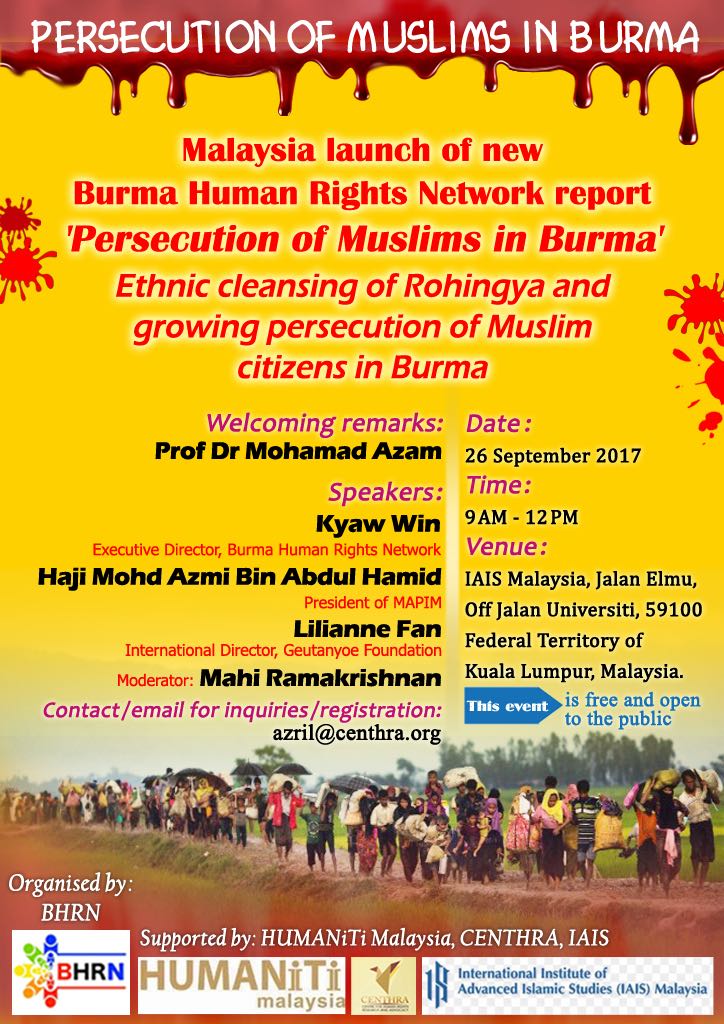
[9] BHRN, ‘Persecution of Muslims in Burma’ (2017) 7. 43-44; BHRN, ‘BHRN Briefing: The State of Religious Freedom in Burma’ (October 2018) 11-12.
[10] Walter, 'Religion or Belief, Freedom of, International Protection’ in Max Planck Encyclopedia of Public International Law (OUP, entry last updated 2008) [8].
[11] UN Human Rights Council, ‘Report of the Working Group on the Universal Periodic Review – Myanmar’ (23 December 2015) UN Doc A/HRC/31/13 12[143]
[12] BHRN, ‘Persecution of Muslims in Burma’ op cit 7, 25-28; BHRN, ‘BHRN Briefing: The State of Religious Freedom in Burma’ op cit 1-2; BHRN, Fundamental Rights Cannot be Voted Down (10 April 2019).
[13] BHRN, ‘Persecution of Muslims in Burma’ op cit 31-32.
[14] International Commission of Jurists, ‘Citizenship and Human Rights in Myanmar’ op cit 5-6.
[15] UN General Assembly, ‘Report of the Special Rapporteur on Minority Issues - Statelessness: a minority issue’ (20 July 2018 ) UN Doc A/73/205 7[22]; UPR Info database on recommendations put forward on statelessness and the right to nationality, available at <https://upr-info-database.uwazi.io/> accessed 26 June 2020; France: Accelerate citizenship verification processes so that populations now deprived of identity documents do not remain in an illegal situation.
[16] BHRN, ‘Existence Denied’ op cit 8, 18-21.
[17] Justice Base, ‘A Legal Guide to Citizenship and Identity Documents in Myanmar’ (December 2018) 6, 10.
UPR Submission PDF File