
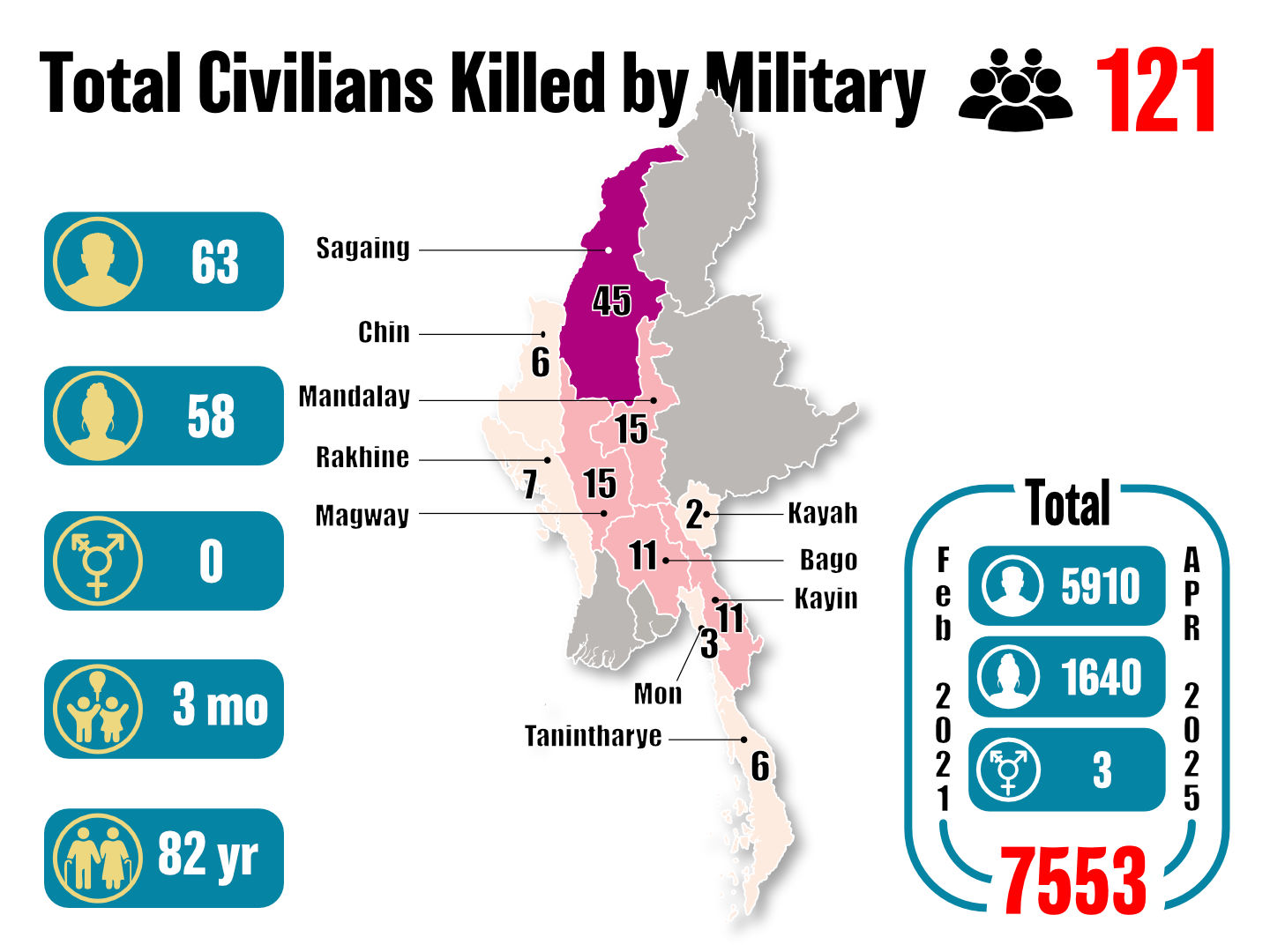
In April 2025, Myanmar’s military junta escalated its campaign of violence against civilians, compounding the suffering of communities already devastated by the 28 March earthquake. Instead of facilitating lifesaving relief, the junta used the disaster as cover to intensify aerial assaults, shelling, and ground raids across the country. Junta forces targeted crowded markets, religious sites, homes, and schools and killing children, elderly people, and entire families.
Despite publicly declaring a ceasefire on 2 April, the junta broke it within hours and continued to carry out operations that targeted civilians and obstructed humanitarian access. In disaster affected areas like Sagaing, Mandalay, and Chin States, airstrikes destroyed churches, monasteries, and shelters, while junta forces blocked aid deliveries and dismantled temporary mosques set up by displaced Muslim communities.
Rohingya communities faced renewed persecution, not only from the junta but also from the Arakan Army (AA), which continues to expand its control across Rakhine State. Throughout April, the AA carried out forced evictions, destroyed homes and places of worship, and ordered entire villages to relocate under threat. The silence of many regional and international actors in the face of these abuses further entrenches a dangerous pattern of selective accountability.
While civilians endured daily violations, resistance forces made significant territorial gains. The capture of key military outposts, towns, and commanders by coordinated pro-democracy forces in Chin, Karen, Kachin, and Shan States demonstrated the junta’s weakening control. However, these advances were met with intensified junta retaliation, including indiscriminate bombing of recently liberated areas and the targeting of civilians perceived to support the resistance.
Following the devastating 28 March earthquake that killed thousands and displaced millions across Myanmar, the military junta responded not with aid, but with intensified attacks on civilians. Despite widespread destruction in areas like Sagaing and Magway, the junta escalated airstrikes and artillery attacks, obstructed aid delivery, and tightened restrictions on communications in opposition-controlled regions. This pattern of behavior reflects a longstanding and deliberate policy of weaponizing crises to entrench military control.
According to the UN Office of the High Commissioner for Human Rights, the junta carried out over 140 airstrikes and 24 artillery assaults between 28 March and 24 April, including at least 73 attacks in earthquake-affected areas. The targeting of civilian structures - including homes, schools, and religious buildings sheltering displaced people - violates core principles of international humanitarian law (IHL), particularly the prohibitions against indiscriminate and disproportionate attacks and the duty to distinguish between civilian and military targets. These acts may constitute war crimes under the Rome Statute of the International Criminal Court.