
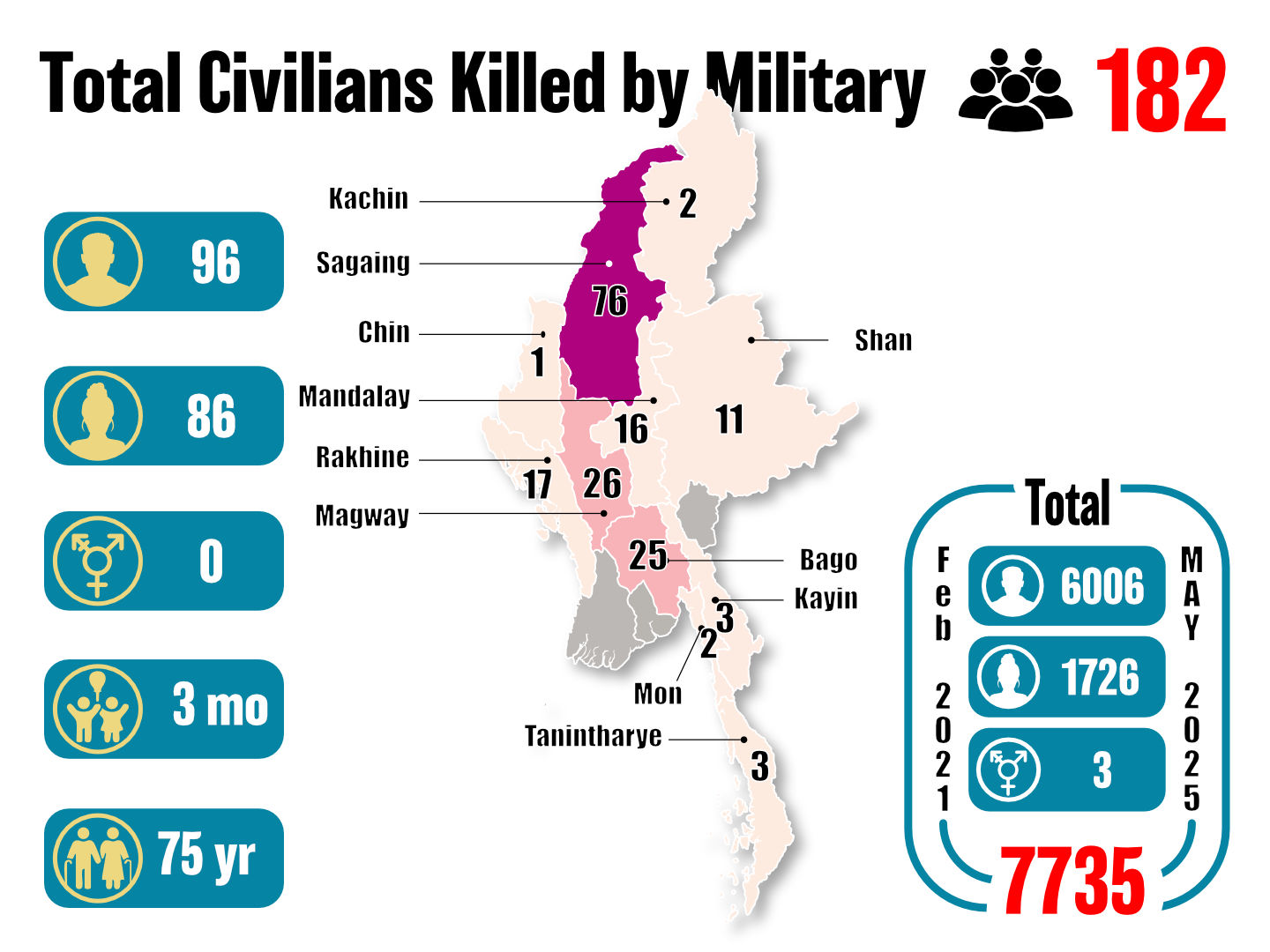
In May 2025, Myanmar’s military junta continued its campaign of deliberate attacks on civilians, deploying increasingly lethal tactics while systematically obstructing aid to earthquake-affected communities. The junta’s use of internationally banned cluster munitions on a school in Sagaing Region, killing 22 children and two teachers, was one of the deadliest single attacks on an education site since the 2021 coup and reflects a growing pattern of direct targeting of civilians and civilian objects in non-combat zones. Throughout the month, BHRN documented repeated junta airstrikes on schools, homes, weddings, monasteries, mosques, and displacement camps, as well as mass arbitrary arrests, enforced disappearances, and the denial of humanitarian assistance to those most in need.
The junta’s violence was mirrored by escalating abuses carried out by the Arakan Army (AA) in northern Rakhine State. In areas under AA control, Rohingya civilians were forcibly evicted, beaten, conscripted into forced labor, and denied access to medical care. Religious sites were confiscated or destroyed, and at least two deadly sea journeys were traced back to AA-perpetrated abuses that pushed Rohingya civilians to flee. Survivors described being extorted, assaulted, and left with no option but to attempt passage to Bangladesh. These actions form part of a growing body of evidence that the AA is systematically targeting the Rohingya population and committing crimes against humanity.
Across Myanmar, junta and AA forces carried out arbitrary arrests and torture with impunity. Political prisoners released under prior amnesties reported ongoing surveillance, blacklisting, and threats of re-arrest. Muslim communities continued to face systemic discrimination, with local authorities blocking efforts to reconstruct earthquake-damaged mosques. In Mandalay and Ayeyarwady Regions, junta forces arrested civilians and business owners on fabricated charges of supporting the resistance, including through forced confessions and extortion. In one case, a Muslim political prisoner died in custody following torture by prison authorities and fellow inmates.
International borders offered no safe haven. In a violation of the principle of non-refoulement, Indian authorities deported at least 30 Rohingya refugees, while a Myanmar national was deported from the United States despite a pending asylum case. Meanwhile, the 46th ASEAN Summit failed to produce any meaningful action on Myanmar, with member states continuing to reaffirm the ineffective Five-Point Consensus while overlooking rising atrocities by both the junta and the AA. Regional companies based in Thailand, Malaysia, and Singapore continued to profit from junta-linked contracts, including in aviation fuel, surveillance systems, and infrastructure, with little regulatory oversight or accountability.
Despite these setbacks, pro-democracy resistance forces achieved notable military gains, seizing junta outposts in Bago, Karen, and Tanintharyi Regions. Most significantly, the capture of the Htee Khee trading corridor disrupted a major military revenue stream and exposed the junta’s growing vulnerability in the southeast. However, junta forces retaliated with drone and airstrikes targeting newly liberated communities and civilians suspected of sympathizing with the resistance. In northern Rakhine, the junta increased aerial bombardments of AA-held towns, contributing to record-high civilian displacement.
May also saw new setbacks for international justice. While universal jurisdiction and International Criminal Court (ICC) processes continued to progress, deportations by democratic governments and corporate complicity in junta-linked disaster relief schemes highlighted the growing gap between public condemnation and actual enforcement of legal norms.
This report documents ongoing violations of international humanitarian law, international human rights law, and international criminal law by the Myanmar military junta, affiliated militias, and the Arakan Army. These include direct attacks on civilians, the use of prohibited weapons, the destruction of religious and cultural property, mass forced displacement, and torture. The international community’s failure to address these abuses, particularly those committed by non-state actors like the AA, has reinforced a system of selective accountability that emboldens perpetrators and undermines victims’ access to justice. As local actors continue to bear the burden of resistance, aid delivery, and documentation, international stakeholders must confront not only the atrocity crimes themselves but the geopolitical and economic structures that enable them.