
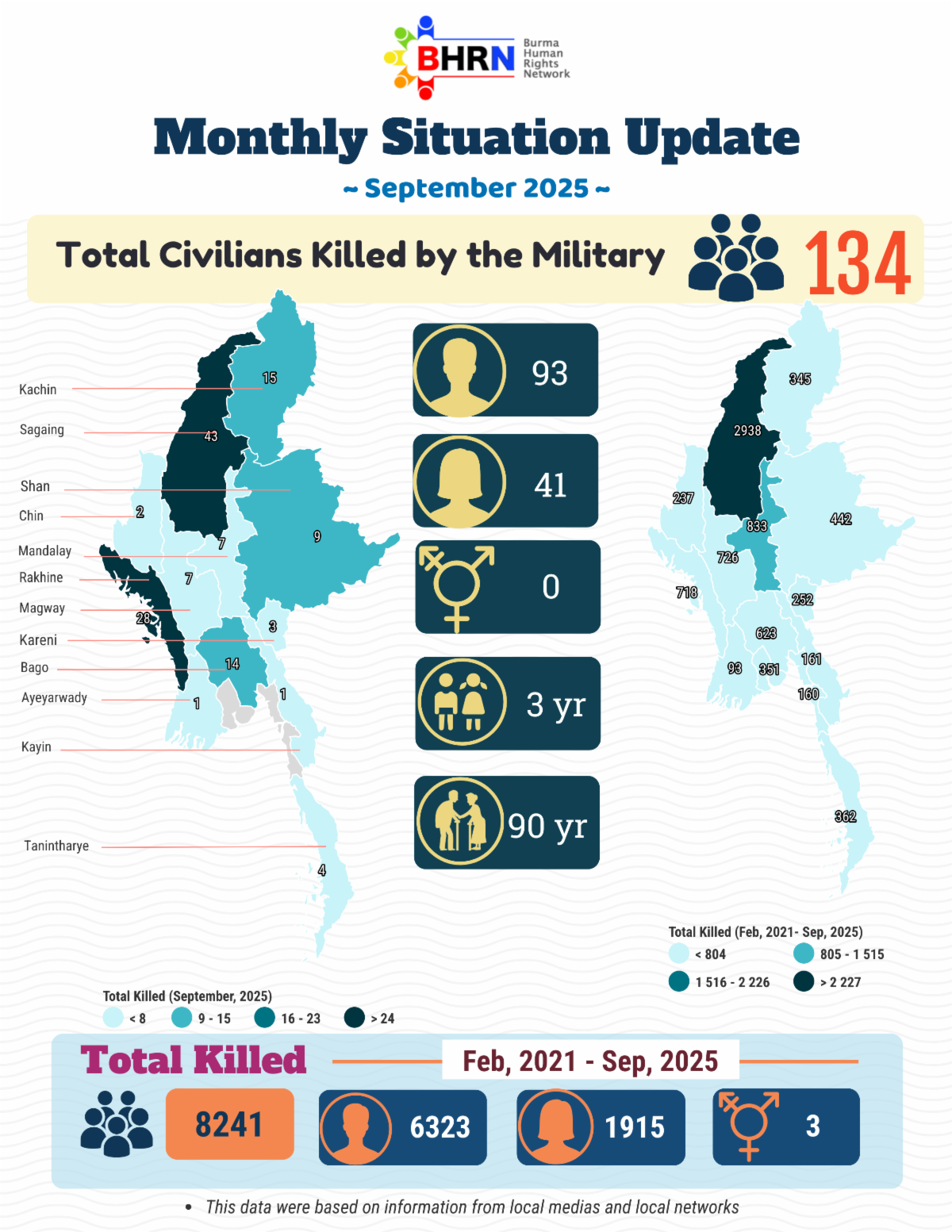
In September 2025, the Myanmar military junta continued laying the groundwork for a tightly controlled first phase of polling scheduled for December, while deepening repression to eliminate scrutiny. The Union Election Commission approved nearly 5,000 candidates under restrictive conditions, barred 56 townships outright, and imposed severe penalties, including against minors, for criticism or perceived disruption of the vote. These developments coincided with the expansion of state surveillance built into national telecom networks, allowing authorities to trace online activity and target individuals for arrest. Taken together, these measures are not designed to reflect the will of the people, but to create the appearance of legitimacy while shielding those in power from scrutiny or accountability.
On the ground, civilians endured intensifying violence. Airstrikes, shelling, and mass arrests targeted villages across Sagaing, Mandalay, and other conflict-affected regions, killing women, children, religious figures, and displaced persons. Several attacks were directed at protected sites such as schools, monasteries, and IDP camps, in violation of international humanitarian law. Reports also emerged of systematic sexual violence by junta forces and renewed abuses by the Arakan Army against Rohingya civilians, including forced relocation, rape, and the targeting of journalists and community leaders. These violations underscore the urgent need for civilian protection, independent investigations, and legal accountability for all perpetrators.
Despite these threats, resistance forces achieved notable advances. Joint PDF–KNLA and PDF–KIA operations seized police stations and townships, while new armed groups emerged in Mon State vowing to block the December election. Internationally, progress continued on accountability pathways: the Burmese Rohingya Organisation UK (BROUK) petitioned Argentine courts to expand their universal jurisdiction case to include Arakan Army leaders. Meanwhile, the United States imposed sanctions targeting trafficking-linked financial networks and illicit procurement channels sustaining the junta’s air war. These developments reflect a growing recognition that meaningful international action, anchored in justice and protection, remains critical to ending impunity and supporting democratic transition.