
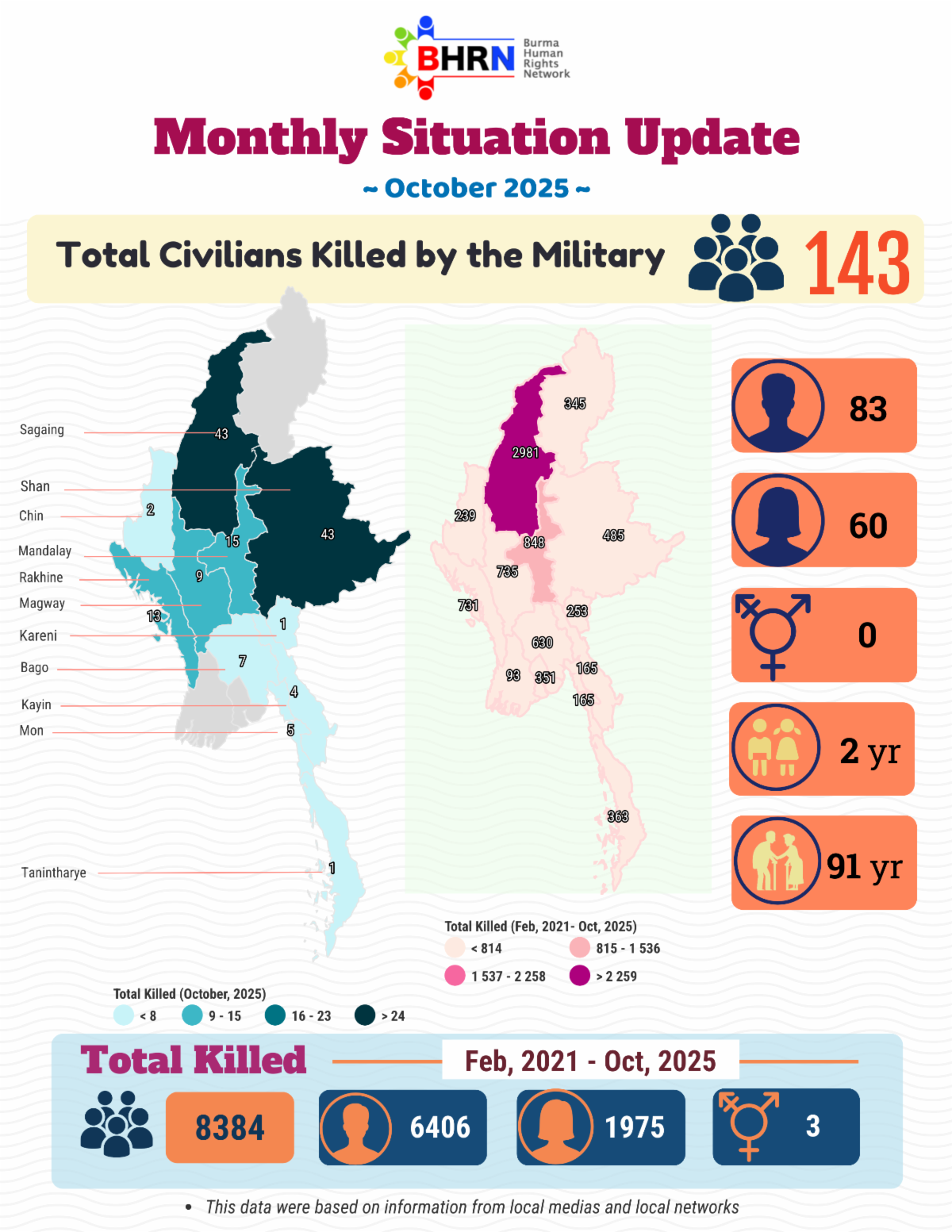
In October, the Myanmar junta ramped up preparations for sham elections in December while systematically coercing participation and attacking civilians across the country. On 16 October, Min Aung Hlaing announced a three-phase timeline covering 274 townships while excluding 56 areas under resistance control. The regime forced internally displaced persons to register as voters in exchange for cash payments, threatened prisoners with solitary confinement unless they cast advance votes, and re-arrested political prisoners at prison gates to silence potential opposition. The junta arrested three prominent artists on 27 October for criticizing an election propaganda film, prosecuted 64 people under a new Election Protection Law authorizing death penalties for vaguely defined "election interference," and banned all campaign rallies. Approximately 55,000 electronic voting machines will replace paper ballots despite serious transparency concerns, while only six parties field national candidates and voter lists contain hundreds of errors including names of deceased people.
While ASEAN issued statements opposing the elections, China and Russia provided material support that gave the regime the international cover it needed. On 15 October, Beijing's Special Envoy Deng Xijun pledged "physical and technical support" for the elections, offering infrastructure, training, and observer participation that insulates the regime from Western sanctions. Russia and Belarus accepted observer invitations while India hedged. Malaysia's Foreign Minister visited Naypyidaw on 9 October, which the junta immediately exploited by falsely claiming Malaysia had agreed to send observers, a lie quickly corrected but only after regime media broadcast the claim. The 26 October ASEAN Summit reiterated that elections must follow ceasefire and dialogue but imposed no concrete measures. Meanwhile, the United Kingdom has imposed no new sanctions for a full year, creating gaps in coordinated pressure. Burma Campaign UK noted that Britain "frequently imposes more sanctions on Russia in a single day than it has on the Burmese military in almost five years," allowing UK-linked institutions to facilitate transactions other jurisdictions have prohibited.
Violence against civilians escalated dramatically as the regime prioritized territorial control. On 7 October, the junta's Joint Operations Command announced plans to double airstrikes over the following two months. The regime deployed paramotors, drones, and gyro-copters, indiscriminate weapons difficult to detect that prevent civilians from protecting themselves. On 6 October, paramotors bombed a crowd celebrating a religious festival in Sagaing's Bone To village, killing at least 40 civilians with 10 more dying later from lack of medical care. Between 1-20 October, at least 30 airstrikes on northern Shan State killed 41 civilians including 8 children and destroyed 138 houses, three schools, and three monasteries. Junta troops bombed internally displaced persons with cluster munitions despite no active conflict, committed sexual violence, used civilians as human shields, and conducted raids killing villagers. In Rakhine State, the Arakan Army subjected Rohingya, Hindu, and Chakma civilians to systematic forced labor, with survivors describing months of forced portering, fortification construction, and unpaid work under threat of execution. The AA also arbitrarily arrested Rohingya fishermen and imposed movement restrictions requiring payments to access medical treatment.
Resistance forces maintained pressure despite junta advances in select areas. The Arakan Army and People's Defence Forces continued operations throughout October to encircle a strategic hilltop base threatening a major munitions factory in Magway that supplies nationwide junta operations, displacing 8,500 people from 20 villages. The Kachin Independence Army regained outposts in Bhamo despite heavy junta reinforcements. Six armed organizations rejected the junta's Nationwide Ceasefire Agreement anniversary ceremony from 15-17 October, declaring the agreement void since the 2021 coup. The regime's announcement to double airstrikes, deployment of indiscriminate weapons against religious gatherings and schools, systematic electoral coercion, Chinese material support, and stagnation of Western sanctions confirm that December elections serve not as democratic transition but as a mechanism to consolidate authoritarian control through manufactured legitimacy while terror remains the primary tool of governance.